
Two project managers begin the same project with identical resources and deadlines. One relies on spreadsheets and monthly reports, causing delays.
The other uses a real-time dashboard that provides immediate insights into labor, costs, and variances. By Friday, the first reacts to overruns, while the second adjusts efficiently and proactively.
The difference isn't experience or effort. It's visibility.
If you've ever wondered how teams like this use software to stay ahead and build disciplined, cost-conscious projects, this blog walks you through exactly how it works.
How Does Construction Software Enable Better Cost Control for Multi-Site Projects?
Construction software consolidates functions such as job costing, project management, finance, document control, reporting, and collaboration into a single platform.
This allows professionals to see real-time cost data, enabling proactive cost control and changing decision-making from reactive to proactive. This unified approach helps construction companies manage budgets, track performance, control costs, and safeguard profits consistently across projects.
Key Takeaways
- Construction software enables real-time job costing instead of delayed financial tracking.
- Cost control improves when field and office teams work from the same data
- Portfolio-level financial insights help construction companies identify recurring cost leakages and prevent the same mistakes from repeating across projects.
- Standardized workflows improve accuracy and financial control
- Early cost insights matter more than perfect reports delivered too late, as proactive decisions protect margins before overruns become unavoidable.
Curious How High-Performing Construction Teams Keep Costs Under Control?
High-performing construction teams don't rely on luck or last-minute fixes. They use construction management software to maintain real-time visibility into project budgets, job costing, purchase orders, and overall financial performance.
When field crews, office teams, and project managers collaborate on a platform, cost control becomes part of daily operations. Schedule a demo to see how this real-time cost management works.
Why Is Cost Control Still So Hard in the Construction Industry?
Cost control is difficult, not because teams lack discipline, but because systems are fragmented. Many construction companies still rely on multiple tools for project management, accounting, document control, and field reporting. These disconnected systems delay information flow and reduce accuracy.
Field crews submit updates late, office teams reconcile data manually, and project managers make decisions without a complete financial context. By the time reports are reviewed, costs are already locked in.
This forces general contractors and specialty contractors into reactive decision-making, where controlling costs feels more like damage control than strategic management.
What Does Cost Control Actually Mean in Modern Construction Projects?
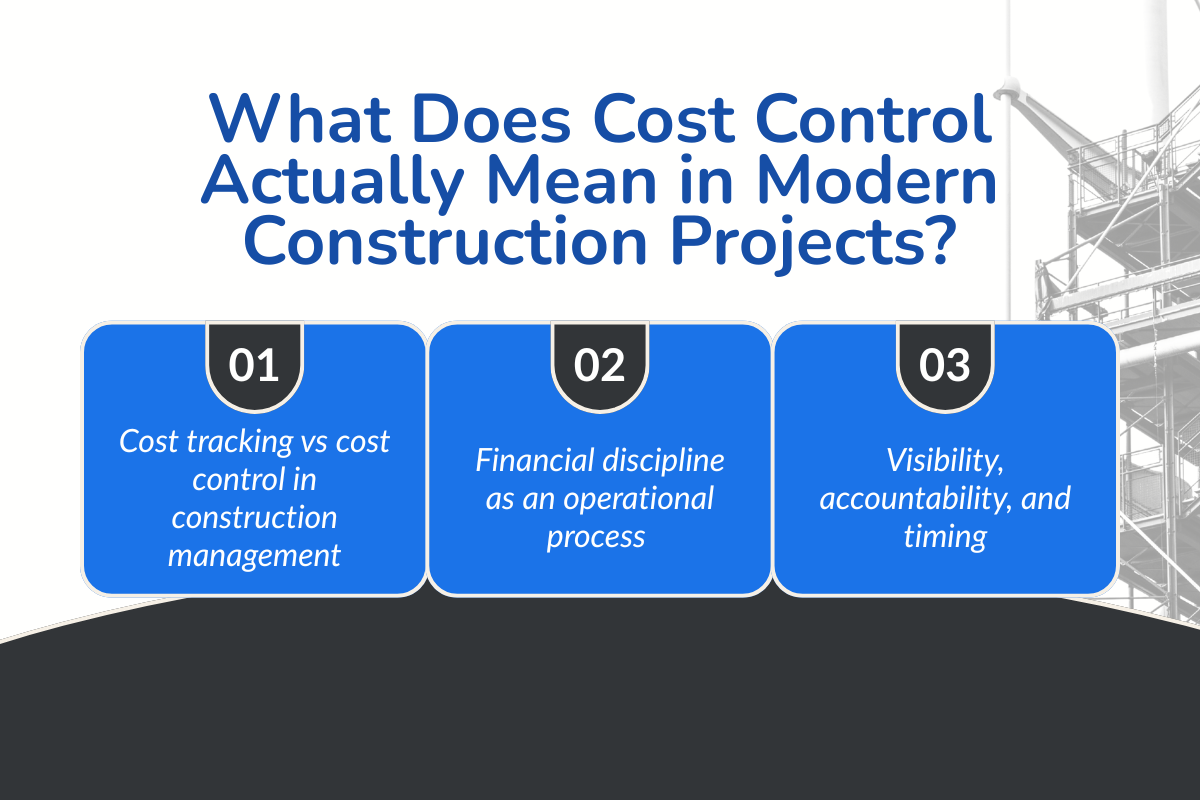
Modern cost control is about influence, not hindsight. It's the ability to guide spending decisions as work progresses across construction projects. Accurate financial control depends on real-time insights, accountability across teams, and systems that support consistent workflows.
Construction management software embeds cost control directly into daily project operations, allowing teams to manage budgets continuously rather than reacting after problems surface.
1. Cost tracking vs cost control in construction management
Cost tracking tells you what has already happened. Cost control helps shape what happens next. Many construction projects rely heavily on historical financial reports, which limit the ability to take corrective action.
Construction management software updates job costing as work progresses, allowing teams to respond early. This distinction significantly improves project budgets, cash flow stability, and overall financial management.
2. Financial discipline as an operational process
Cost control cannot live only within finance teams. Field crews, project managers, and office teams all influence financial outcomes.
Construction software standardizes how costs are captured, approved, and reported across the entire business. Automated workflows reduce errors, improve accuracy, and ensure consistent financial discipline across projects.
3. Visibility, accountability, and timing
Early visibility creates opportunity. Accountability assigns responsibility. Timing allows meaningful action.
Cloud-based construction management software provides real-time insights that teams trust. This improves collaboration between field teams and office teams while reducing friction between project management and finance.
How Construction Software Improves Cost Visibility Across Projects?
Visibility is the foundation of effective cost control. Without clear, timely access to project information, even experienced construction professionals struggle to manage costs.
Construction software centralizes financial data, creating a single platform where job costing, project budgets, purchase orders, and change orders stay connected across multiple construction projects.
1. Centralized job costing across construction projects
Spreadsheet-driven reporting becomes unreliable as projects scale. Centralized job costing consolidates estimates, committed costs, and actuals into a single system.
Cloud-based construction management software supports consistent reporting and real-time visibility, enabling construction companies to make data-driven decisions with confidence.
2. Real-time budget vs actuals
Real-time budget tracking surfaces issues early, preventing them from escalating into significant overruns. Construction software compares budgets to live costs as field activities occur.
Industry research shows that digital cost control and real-time insights can significantly improve efficiency by reducing rework, delays, and surprise expenses across projects.
3. Connecting field crews to financial management
Mobile-first construction software enables field crews to update labor hours, materials used, and job progress directly on-site.
These updates are reflected immediately in the office dashboards. This connection improves accuracy, reduces administrative workload, and turns daily site activity into actionable financial data.
4. Forecasting final project cost
Forecasting is no longer guesswork. Construction software analyzes real-time data to project where costs are headed.
Predictive indicators highlight risks early, helping construction professionals adjust labor allocation, procurement timing, or scope before costs spiral out of control.
Where Do Construction Projects Typically Lose Cost Control?
Cost control rarely collapses all at once. It erodes through small blind spots that compound over time. It starts with:
- Change orders are tracked too late.
- Labor costs remain hidden within broad categories
- Material overruns go unnoticed until invoices arrive.
- Decisions are made without complete financial visibility.
Construction management software these gaps by embedding cost awareness into everyday workflows rather than relying on periodic reviews.
To gather more details about a solution that will strengthen cost management practices, read How Construction Software Boosts Efficiency and Financial Mastery.
How Construction Management Software Enforces Financial Discipline?
Financial discipline works best when systems consistently support it. Construction management software replaces informal practices with standardized workflows, automated controls, and real-time reporting.
This structure reduces errors, improves accuracy, and protects margins across construction projects without slowing teams down or adding unnecessary complexity.
1. Standardized workflows across construction management
Standard workflows remove interpretation from cost reporting and approval processes. Construction software ensures consistent financial data across projects, enabling reliable comparisons and better decision-making at both project and portfolio levels.
2. Role-based permissions and approvals
Unauthorized spending often happens unintentionally when approval processes are unclear. Role-based permissions ensure spending authority matches responsibility.
Construction management software quietly enforces these controls, helping teams maintain financial control without disrupting productivity or collaboration.
3. Automated alerts for budget variance
Automated alerts act as early-warning systems. Construction software continuously monitors budget thresholds and spending patterns. When labor, material, or subcontractor costs drift, alerts prompt timely review, allowing teams to correct issues before profitability is impacted.
4. Accountability without micromanagement
When financial data is visible and trusted, accountability follows naturally. Project managers spend less time chasing updates, and teams align around shared numbers. Software enforces consistency, allowing leaders to focus on strategy, performance, and growth.
How Cost Control Improves Across Multiple Construction Projects?
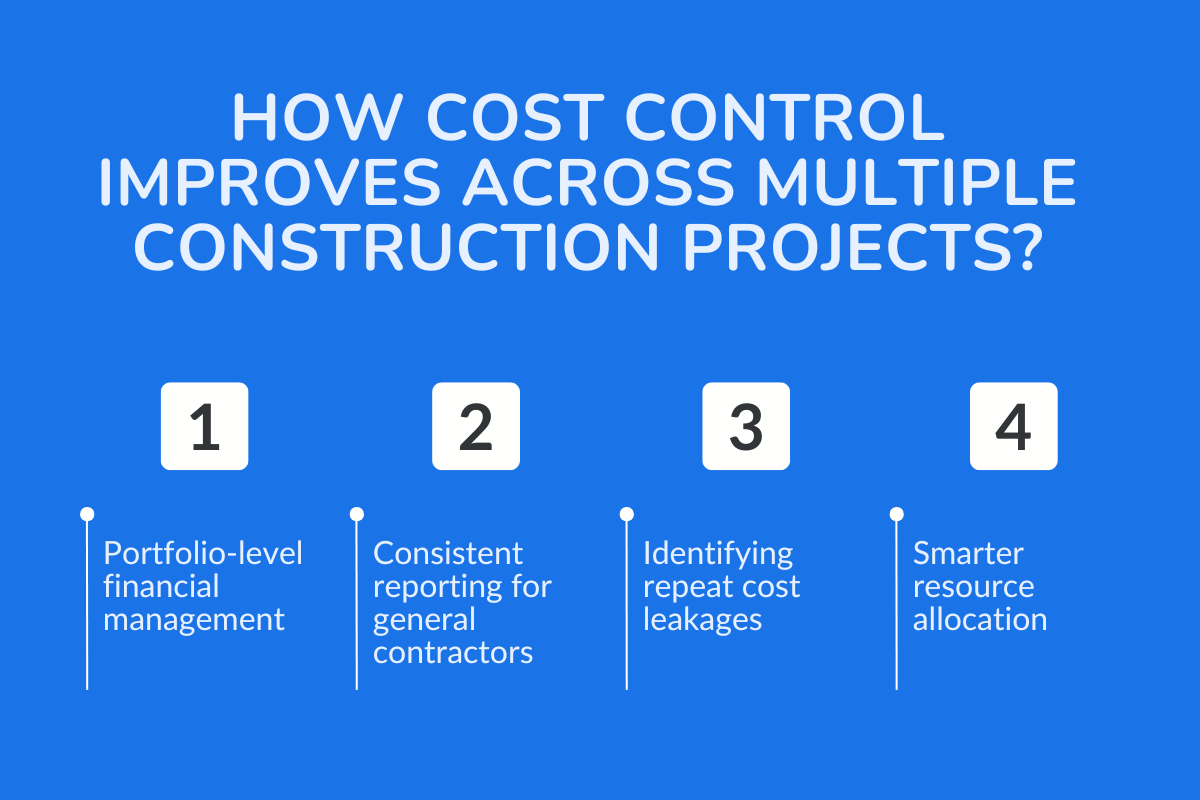
Managing one construction project is complex. Managing multiple projects without unified data significantly increases risk.
Construction software provides portfolio-level financial management that reveals trends, patterns, and performance issues that individual project reviews often miss.
1. Portfolio-level financial management
Portfolio views show how costs, budgets, and profitability perform across all projects. Construction companies identify risks early and adjust strategies before issues repeat across jobs.
2. Consistent reporting for general contractors
Standardized reporting enables general contractors to accurately compare job performance across construction projects. Consistency improves trust in reported numbers and supports smarter, data-driven decisions at the business level.
3. Identifying repeat cost leakages
Historical cost data reveals recurring issues such as labor inefficiencies or delayed change orders. Construction professionals use these insights to create safeguards, improving long-term performance and financial control.
4. Smarter resource allocation
Real-time insights support better labor scheduling, budget allocation, and resource planning. Construction companies assign resources based on actual performance rather than assumptions, improving efficiency and profitability.
What Happens When Cost Control Is Reactive Instead of Proactive?
Reactive cost control leads to surprise overruns at project closeout. Margins erode quietly across construction projects.
Tension grows between project management and finance teams, and trust in reported data declines. These challenges are common when teams rely on delayed reports instead of real-time visibility.
If delayed visibility is creating budget surprises, these practical budgeting tips for construction firms show how teams can regain control before issues escalate.
How Construction Software Shifts Cost Control From Reactive to Proactive?
Construction software changes when teams receive financial information. This earlier visibility leads to better decisions.
This shift transforms cost control from a corrective process into a preventive, data-driven practice that supports long-term success.
- Continuous cost monitoring: Costs are reviewed daily rather than monthly. Construction software updates job costing continuously, ensuring project budgets reflect real conditions as work progresses.
- Early-warning indicators: Leading indicators matter more than lagging reports. Predictive insights highlight risk signals early, giving teams time to act before issues escalate.
- Faster decision-making: When data is current and accessible, decisions happen faster. Project managers adjust scope, labor, procurement, or schedules before costs spiral out of control.
What Should Construction Professionals Look for in Cost Control Software?
Choosing the right software means evaluating how well it fits daily construction workflows—not just how many features it claims to offer.
1. Real-Time Job Costing: The software should show labor, material, and subcontractor costs as work happens, not weeks later. This allows teams to catch overruns early and take corrective action before margins are affected.
2. Project-Level and Portfolio-Level Cost Visibility: Contractors need visibility at both the individual project level and across multiple projects. This helps leadership compare performance, spot patterns, and manage risk at scale.
3. Built-In Change Order Tracking: Change orders should be logged, approved, and reflected in budgets immediately. Manual tracking increases the risk of missed costs and billing disputes.
4. Seamless Accounting Integration: Integration with accounting tools ensures financial data stays accurate and consistent without duplicate data entry between systems.
5. Forecasting and Variance Analysis: The software should compare actual costs against estimates and forecasts, highlighting variances early so teams can adjust schedules, resources, or spending.
6. Ease of Use for Field and Office Teams: Cost control only works when everyone uses the system. An intuitive interface ensures field crews, project managers, and finance teams update data consistently.
7. Mobile and Cloud-Based Access: Teams should be able to review and update cost information from the job site, office, or remote locations without delays.
8. Audit Trails and Cost History: A clear record of cost changes, approvals, and historical data helps with accountability, dispute resolution, and future project planning.
9. Scalability for Growing Operations: The platform should support more projects, users, and locations without becoming complex or slowing down workflows.
Common Misconceptions About Construction Cost Control Software
“It’s only for finance teams.”
Cost control software is used by project managers, site engineers, and leadership, not just accounting. It gives everyone visibility into budgets, spending, and job performance.
“Spreadsheets are enough.”
Spreadsheets depend on manual updates and delayed reporting. They lack real-time accuracy and quickly break down when managing multiple projects or when faced with frequent change orders.
“Software can’t prevent cost overruns.”
Modern construction software helps identify issues early through live job costing, variance tracking, and change-order monitoring, allowing teams to act before costs escalate.
“It adds complexity to operations.”
Today’s platforms are built to simplify workflows by automating data entry, standardizing processes, and reducing back-and-forth between teams.
“Field teams won’t use it.”
Mobile-friendly tools with simple interfaces make it easier for field teams to log updates, ensuring cost data stays accurate and up to date.
“It doesn’t improve accountability.”
In reality, shared dashboards and real-time reporting create transparency, making it clear where costs originate and who owns each decision.
Misconceptions about cost control often begin during estimating. This breakdown of 5 Common Construction Estimating Mistakes highlights where projects go off track and how better systems prevent these issues early.
How Strong Cost Control Improves Long-Term Construction Business Performance?
Strong cost control protects margins across construction projects. Accurate data improves bid accuracy and forecasting. Construction companies scale operations without losing financial control.
Predictable outcomes build trust with clients, subcontractors, and stakeholders, supporting sustainable business growth.
How ConstructionBase Helps Control Costs Across Construction Projects?
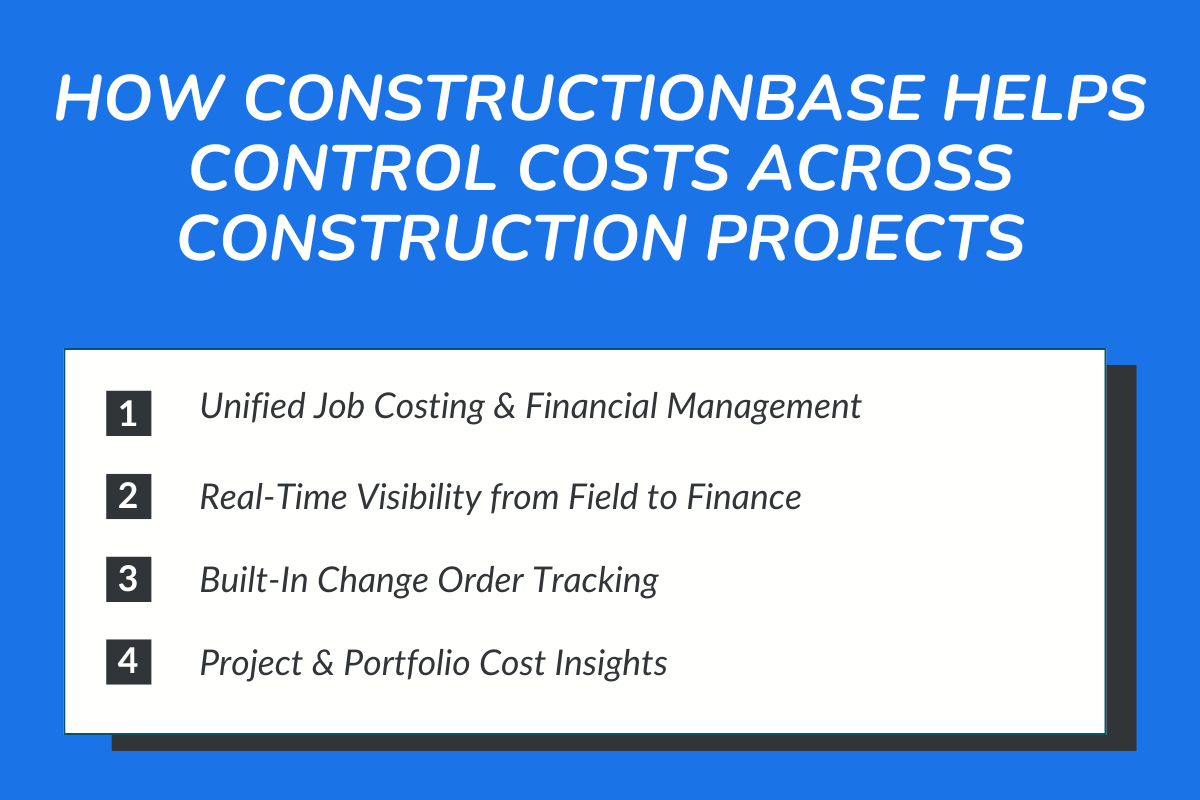
ConstructionBase is designed to make disciplined cost control part of everyday operations by giving teams real-time financial visibility without added complexity.
By unifying project management, job costing, and financial management in a single platform, it eliminates guesswork and helps teams consistently control costs across projects.
1. One platform for job costing and financial management
Estimates, committed costs, and actuals coexist in one system, eliminating spreadsheet reconciliation and boosting accuracy.
With all data in one place, project managers avoid cross-checking multiple tools. This unified system enhances financial control, job tracking, and speeds up decision-making in construction projects.
2. Real-time visibility from the field crew to finance
Field crews update progress and costs directly on site, ensuring data is captured as work progresses. Office teams see updates instantly, improving collaboration and trust in reported numbers.
This real-time connection reduces delays, minimizes miscommunication, and keeps project budgets aligned with reality throughout the project lifecycle.
3. Built-in change order tracking
Change orders are quickly captured, approved, and reflected in project budgets, preventing hidden overruns.
ConstructionBase manages change orders within workflows, keeping scope changes financially visible. This safeguards margins and ensures transparency with clients and stakeholders.
4. Project-level and portfolio-level cost insights
Leaders evaluate individual performance and portfolio trends to gain a broad financial perspective.
This helps construction companies spot recurring cost issues and apply lessons across projects, boosting long-term financial control and stability.
In a Nutshell
Construction software improves cost control by delivering real-time visibility, standardizing workflows, and connecting field and office teams through shared data.
This alignment reduces delays, improves accuracy, and supports better collaboration across construction projects.
Early insights help construction companies protect margins, improve efficiency, and manage growth confidently without increasing administrative burden.
Why ConstructionBase?
ConstructionBase helps construction companies replace fragmented tools with one connected platform built specifically for construction workflows.
By aligning field activity, job costing, and financial oversight, teams gain accuracy, efficiency, and confidence across every project.
This unified approach supports disciplined financial management while allowing teams to scale operations without losing control. If you're still waiting to see how this functions in real workflows, here is a solution: Schedule a demo with ConstructionBase!
FAQs
1. How does construction software improve job costing accuracy?
Construction software centralizes estimates, actuals, and committed costs, enabling construction professionals to track job costing accurately in real time across construction projects without relying on spreadsheets.
2. Why is construction management software essential for general contractors?
Construction management software gives general contractors real-time visibility into project budgets, field activity, and financial performance, enabling better coordination and stronger financial control.
3. How does construction software improve collaboration between field crews and office teams?
Mobile access enables field crews to update progress and costs in real time, keeping office teams aligned with data-driven insights that support efficient project management.
4. Can construction software help manage change orders effectively?
Built-in change order tracking ensures scope changes are captured early, approved properly, and reflected in project budgets to prevent unexpected cost overruns.
5. How does one platform improve cost control across multiple construction projects?
A single platform provides portfolio-level visibility, consistent reporting, and centralized financial management, helping construction companies reduce risk and protect profitability.
Have questions or need personalized advice?
Talk to an Expert Today and let our construction specialists guide you to success.
Related Posts
Building Construction Project Software: Key Integration Points You’re Missing