When most people think about construction project management software, they think of schedules, timelines, and task assignments. While scheduling is important, it’s only a small part of the picture. The real value of modern construction software shows up where it matters most—cost control.
Thus, it is time to raise the curtain on the challenges lurking in construction projects, such as poor planning, inaccurate cost estimates, and frequent design changes that push up your budgets and timelines beyond repair.
If your team is facing the same challenges, it is time to gear up with a smart project management software solution that will strengthen cost management practices and maintain timelines for successful project delivery.
How Construction Project Management Software Cost Control Features Boost Efficiency and Financial Mastery?
Construction project management (CPM) software cost control features boost efficiency and financial mastery by providing real-time visibility, automating critical tasks, and improving data accuracy, leading to enhanced decision-making and better project outcomes.
In construction, even small delays or missed cost updates can quickly snowball into major overruns, putting profit margins at risk. And without clear financial oversight, issues often surface only after they’ve already impacted the bottom line.
However, with the right software, contractors can control project costs while streamlining workflows to save both time and money. So, this blog will walk you through how project management software can act as a single unified tool that can provide complete control over finances and project timelines, and simplify the complexities of construction project execution.
Key Takeaways
- Construction projects need to stay on schedule and within budget to sustain profitable margins in a dynamic and highly competitive industry.
- Controlling unexpected costs that push budgets over the limit is a persistent challenge due to manual workflows, unforeseen changes, and poor tracking of financials throughout the construction projects.
- Construction cost management software that seamlessly integrates with other accounting tools provides complete financial visibility, real-time updates to identify overspending, and cost estimates for smarter bids.
- Advanced features like forecasting and risk analysis account for inflation and other factors, enabling proactive steps to manage costs effectively.
Stop guessing where the money goes
See how real-time cost visibility, smarter forecasting, and connected workflows can protect your margins on every project. Book a personalized ConstructionBase demo and take control of your budgets before overruns happen.
Why Controlling Costs Is a Persistent Problem in the Construction Industry?
1. Manual Hiccups:
When the existing system depends on spreadsheets, clipboards, and outdated accounting software, the project managers often end up reviewing outdated financial information, which only gets refreshed after manual data entry.
The time gap spirals up the costs due to last-minute material need changes, client design revisions, or unexpected disruptions that add thousands of dollars to the project.
Ultimately, it squeezes profit margins and pushes project deadlines further away, damaging customers' trust. 75% of projects exceeded the planned budgets, with an average cost increase of 15% due to mid-project changes.
2. Cost Control Challenge:
Protecting profit margins and maintaining healthy cash flow requires disciplined cost management across every phase of a construction project. To do that effectively, teams must understand two closely related but very different concepts: budget setting and cost control.
Budget setting is the starting point. It involves estimating and planning total project costs before the first brick is laid, giving the project a clear financial framework from day one.
Cost control builds on that foundation. It focuses on tracking, monitoring, and managing expenses as work progresses, ensuring actual spending stays aligned with the original plan and doesn’t quietly spiral out of control.
The distinction matters. Budget setting defines the roadmap, while cost control is what keeps the project on track—helping teams spot issues early, make timely adjustments, and protect profitability throughout execution.
How The Traditional Project Management Software Falls Short?
The most popular and trending project management systems excel only in scheduling and resource management. These tools are schedule-centric, which facilitates scheduling, optimized resource allocation, real-time progress monitoring, and a centralized communication platform.
But the biggest loophole is that these platforms fail to provide visibility into actual construction cost data. They do not offer monitoring and forecasting features to track costs across the multiple phases of project implementation. This often leads to breaking the budget, and expenses go beyond control, creating a financial crunch.
Real-Life Scenario:
A construction project revealed positive task performance, with all phases completed within set deadlines, but the financial report was a red flag, indicating losses.
It failed to monitor extra labor, emergency material purchases, and machine failures during project implementation, which added extra expenses and leaked profits, causing financial goals to be missed.
So, here we identified the biggest loophole in schedule-centric project management software, which can ultimately impair the project's financial health.
What Exactly is the Construction Project Management Software and How Does It Help Control Costs?
When traditional tools fail to deliver accurate cost control, the solution shifts to an integrated software system that streamlines the entire construction project lifecycle. Let us explore what these tools really mean and their importance for the construction project teams.
Decoding Construction Project Management Software:
Construction Project Management Software is a unified digital tool that streamlines construction project workflows with advanced features such as a centralized communication platform, real-time updates, document management, safety tracking, optimized scheduling of jobs and resources, and efficient cost management activities.
For a comprehensive overview of tools, workflows, and real-world use cases, read The Ultimate Guide to Construction Project Management Software.
Unlocking Cost Control with Project Management Software
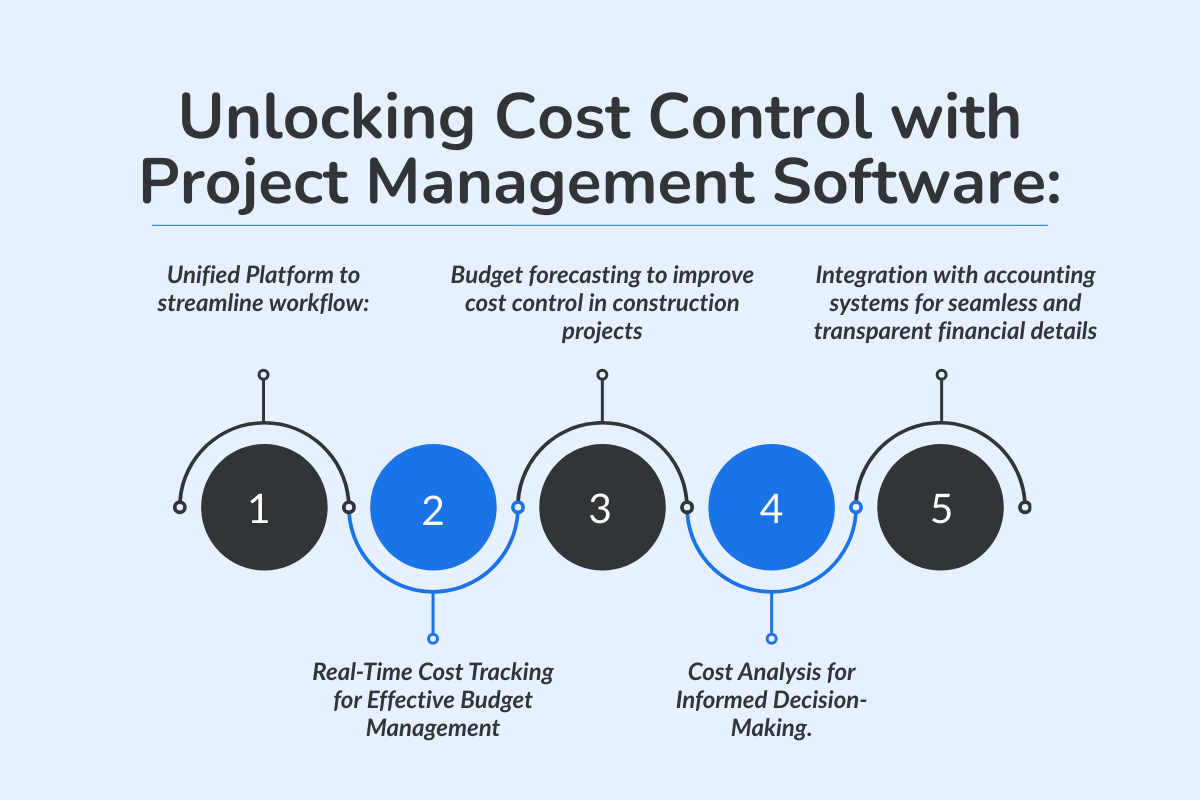
Here are the core features of the project cost management software that help to reduce cost-related risks:
1. Unified Platform to streamline workflow
It is a digital tool for scheduling, resource allocation, and budgeting, all within a single unified platform, enabling project management without switching between multiple tools.
2. Real-Time Cost Tracking for Effective Budget Management
Real-time cost tracking for ongoing project expenses, such as material costs, labor charges, equipment handling fees, subcontractor rates, and other operational expenditures, helps project managers to monitor spending and adjust plans to prevent budget overruns.
3. Budget forecasting to improve cost control in construction projects
Historical and current data help predict costs, enabling smarter planning and more efficient cost control through realistic budgets and strategies that protect profit margins, thereby enhancing the potential for project success.
4. Cost Analysis for Informed Decision-Making
It involves understanding project costs for every phase under varying conditions, such as supply chain inflation, rising labor costs, or volatile market conditions, enabling more informed decisions to control budget deficits.
5. Integration with accounting systems for seamless and transparent financial details
It provides up-to-date visibility of all critical financial data at every construction phase, creating a complete audit trail to identify expenses and enable immediate actions to streamline cost workflows at any stage.
Many teams struggle with disconnected tools—this breakdown of key construction project software integration points highlights what’s often missing.
Maximizing ROI with Construction Management Software: How Better Cost Visibility Turns Projects into Profitable Outcomes
Construction management software delivers ROI not by adding more features, but by giving teams tighter financial control, clearer accountability, and faster, smarter decisions across the entire project lifecycle. When cost data is accurate, visible, and actionable, profits stop leaking quietly in the background.
Here’s how the financial impact shows up in real terms:
1. Smarter, Faster Financial Decision-Making
Modern construction management platforms centralize cost data from labor, materials, equipment, and subcontractors into real-time dashboards. Instead of waiting for monthly reports or post-project reviews, managers can see cost trends as they develop.
This allows teams to:
- Identify budget risks early, not after the damage is done
- Adjust schedules, procurement, or staffing before overruns escalate
- Compare actual costs against estimates to improve future planning
In short, decisions move from reactive to proactive, which directly protects margins.
2. Stronger Cost Accountability Across Teams and Subcontractors
One of the biggest causes of budget overruns is unclear responsibility. Construction management software solves this by linking costs directly to:
- Specific tasks or work packages
- Individual teams or departments
- Subcontractors and vendors
When everyone can see where money is being spent and who owns each cost, accountability improves naturally. Teams become more cost-conscious, change orders are easier to track, and unnecessary expenses are flagged early.
This level of transparency reduces disputes, limits cost creep, and ensures budgets are respected across the board.
3. Improved Stakeholder and Client Communication
Clear financial reporting isn’t just an internal benefit; it strengthens relationships with clients, investors, and senior leadership.
With real-time financial visibility, teams can:
- Share accurate budget updates at every project phase
- Clearly explain cost changes, variations, or delays
- Back up decisions with real data instead of assumptions
This transparency builds confidence, reduces friction during reviews, and positions your company as organized, professional, and financially disciplined.
Beyond features and dashboards, the real value lies in measurable outcomes—see The Real ROI of Construction Project Management Software.
When Should Construction Companies Implement Construction Cost Management Software for Cost Control? (Timing is the Key)
Several indicators in construction companies signal trouble for your financial blueprint. Let us uncover them:
1. Frequent Budget Deficits:
When construction project costs consistently exceed predefined expense parameters, it imposes a significant financial burden on construction companies.
2. Manual System Inefficiencies:
Manual tracking fails to provide real-time project data updates, making it difficult to identify financial loopholes before it is too late to take corrective action.
3. Managing Multiple Complex Projects:
Robust planning helps create custom budget structures that require constant monitoring to manage price fluctuations and unforeseen site conditions. Poor risk management further escalates these costs, resulting in unplanned expenses and ultimately compromising your financial earnings.
Ideal Timing To Invest in Cost Management Software
"Never put off till tomorrow what you can do today." - Lord Chesterfield
So, there is no ‘perfect’ time to wait — the right time is today! Early adoption is key to planning your budget in an organised way and continuously monitoring every expense to maintain financial discipline.
Streamlining construction workflows is impossible until your team adopts and excels at using every core feature of the construction cost management software, which helps plan, track, monitor, and control expenses.
Your financial strength improves when you take charge with the right system for efficient cost management.
Implementation Tips for Maximum Construction Cost Control
1. Train your team:
Streamlining construction workflows will never be possible until your team adopts and excels at using every core feature of the construction cost management software for planning, tracking, monitoring, and controlling expenses.
2. Set up clear workflows:
The budget blueprint must be defined for all construction cost activities, from procurement and change orders to invoicing and expenses, to document every phase accurately. This ensures precise forecasting, reliable estimates, and a healthy financial flow.
3. Monitor KPIs regularly:
Construction cost management software transforms budget control from a reactive process into a proactive one. It uses real-time dashboards to track every dollar spent and monitor how resources are being used.
When costs start to drift off track, teams can spot the issue early and take corrective action before it impacts the overall budget.
4. Iterate and Improve:
Cost control is continuous, not a one-time task. After each project, budgets should be reviewed against performance dashboards to compare planned vs. actual costs and identify fluctuations. These insights help refine future budgeting with corrective actions.
How ConstructionBase Supports Budget and Schedule Control?
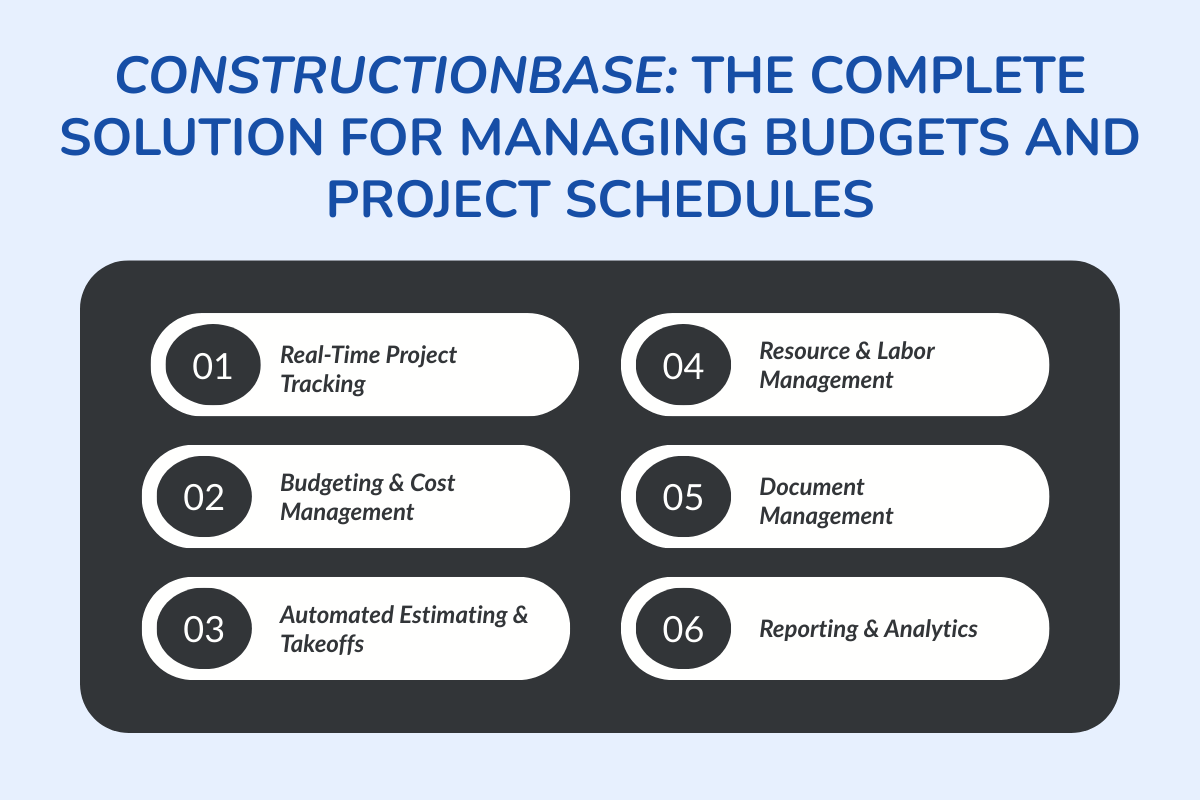
ConstructionBase is designed to bring budgeting and scheduling into a single, connected workflow, rather than treating them as separate processes. Project costs, timelines, and task progress are updated in real time, allowing teams to see how scheduling decisions directly impact budgets.
Instead of relying on disconnected spreadsheets or manual updates, ConstructionBase centralizes financial data, resource allocation, and project timelines in one platform.
1. Real-Time Project Tracking
Integrated communication tools that keep the team members from field techs to the office and the clients synced with real-time updates. It notifies key members of project updates to streamline the workflow.
2. Budgeting & Cost Management
Live dashboards track budgets and actual costs in real time. They highlight changes in labor, material, and equipment expenses as they happen. The system also flags unplanned costs early, helping teams spot budget deviations quickly and make informed decisions to maintain financial visibility and control.
3. Automated Estimating & Takeoffs
Extracts data directly from construction site blueprints and drawings to generate precise material lists and labor requirements, saving valuable time, enhancing accuracy, and reducing costs.
The software also uses live material costs and labor rates to create smarter, more profitable estimates for clients.
4. Resource & Labor Management
Asset management supports the entire project by tracking real-time labor availability for optimized scheduling and monitoring inventory to prevent overstocking or stock-outs.
This minimizes financial leakage, improves resource utilization, and keeps overall project costs under control.
5. Document Management
Create custom document templates for every client proposal by pulling real-time costs for materials, labor, and equipment to generate accurate estimates with auto-applied taxes and fees, ensuring your profit margins stay protected.
The system also stores all discounts in a centralized system and provides access to key stakeholders, eliminating the chaos of duplicated or misplaced files.
6. Reporting & Analytics
With built-in analytical tools, financial dashboards display progress, delays, and detailed cost breakdowns, enabling project managers to implement data-driven strategies that keep construction projects on schedule and within pre-defined budgets to maintain a healthy profit margin.
Conclusion: Stop Tracking Time and Start Controlling Budgets
Budget control is not just a process but a defined roadmap to spot financial leaks before the entire project's finances sink!
The solution? Construction cost management software helps you stay organized, prevent unexpected expenses from piling up, and complete projects within budget.
If your current tools focus only on timelines, you’re only solving half the problem. The future of construction management belongs to teams that can manage time and money with the same level of clarity.
Take Charge of Your Finances and Protect Your Profits
ConstructionBase is an all-in-one platform to help you control costs and boost profits. It replaces the patchwork of spreadsheets, emails, and disconnected tools that many contractors still rely on and offers a streamlined, transparent workflow that supports both office staff and field teams.
If you, too, want every move to be a calculated action to secure profitability and smooth operations, then book a personalized expert-led demo with us. Discover why industry leaders choose us as their financial control partner.
FAQs
1. How does construction project management software prevent budget overruns?
Project Management software has core features like tracking expenses, risk identification, resource allocation, and fostering better communication to reduce overrunning the proposed project budget.
2. Can Project Management software help if my project is already midway and over budget?
Yes, project management software is extremely helpful for ongoing projects that are exceeding budget. It provides complete visibility across every project stage, helping teams identify bottlenecks that lead to financial overruns or operational delays.
Additionally, AI-powered analytics can forecast future costs, enabling better resource allocation, smarter decision-making, and proactive control over all construction project costs.
3. What are the 7 C's of project management to boost efficiency?
Clarity, communication, competency, collaboration, constraints, control, and closure are key project management principles that boost efficiency. They help establish clear objectives, encourage effective teamwork, improve project monitoring, and ensure organized resource allocation for smooth operations.
Have questions or need personalized advice?
Talk to an Expert Today and let our construction specialists guide you to success.
Related Posts
Building Construction Project Software: Key Integration Points You’re Missing