Key Takeaways
- AI-assisted tools improve takeoffs by quantifying estimates with real-time pricing, helping reduce budget overruns and resource shortages.
- Automation replaces repetitive manual tasks, which are time-consuming and error-prone, with better accuracy, increasing trust and bidding success.
- Predictive analytics helps detect budget overruns or resource wastage early, preventing costly project delays.
- Explore top AI tools that help construction managers deliver faster, more accurate estimates for profitable bids.
Introduction
AI construction software is rapidly becoming a core part of modern estimating workflows, especially for small builders, where even minor manual takeoff errors can lead to significant cost overruns.
Instead of replacing builders, AI is being used to eliminate these inaccuracies by automating takeoffs, improving precision, and increasing bidding speed.
With volatile material costs and tighter project timelines, small errors in estimation can quickly turn into lost margins and delayed projects. Relying on manual processes in this environment is no longer just inefficient; it’s financially risky.
Today’s AI tools are more accessible than ever, offering practical solutions tailored to different business sizes and budgets.
Understanding how AI is actually applied in construction estimating, and where it delivers measurable impact, can help builders reduce errors, improve bid accuracy, and make more profitable project decisions.
How Does AI Construction Software Improve Estimate Accuracy and Streamline Project Execution?
The construction industry is moving beyond dashboards, tape measures, rulers, and manual calculations toward AI-assisted estimation software.
AI tools are emerging as a powerful solution to generate fast, accurate, and competitive bids while allowing contractors to focus on planning, risk analysis, and strengthening client relationships. It streamlines project execution through predictive analytics, real-time material price tracking, and proactive risk detection, which prevents scheduling delays and budget overruns.
However, this is only part of the picture. In this blog, we go deeper into why AI-driven construction estimating software is becoming essential, explore real-world use cases, and review the top tools suited for different business sizes and workflows.
Join hundreds of small builders who've doubled their bidding capacity. Book Your Personal Demo.
The Estimating Error Nobody Talks About And Why It Is Getting Worse for Small Builders
Small builders rarely lose money because of one big mistake; it is the small, hidden estimating errors that add up over time. As projects become more complex and prices more volatile, these gaps are getting harder to detect and more expensive to fix.
Let’s break down the most common estimating errors that quietly impact profitability and why they are becoming more frequent today.
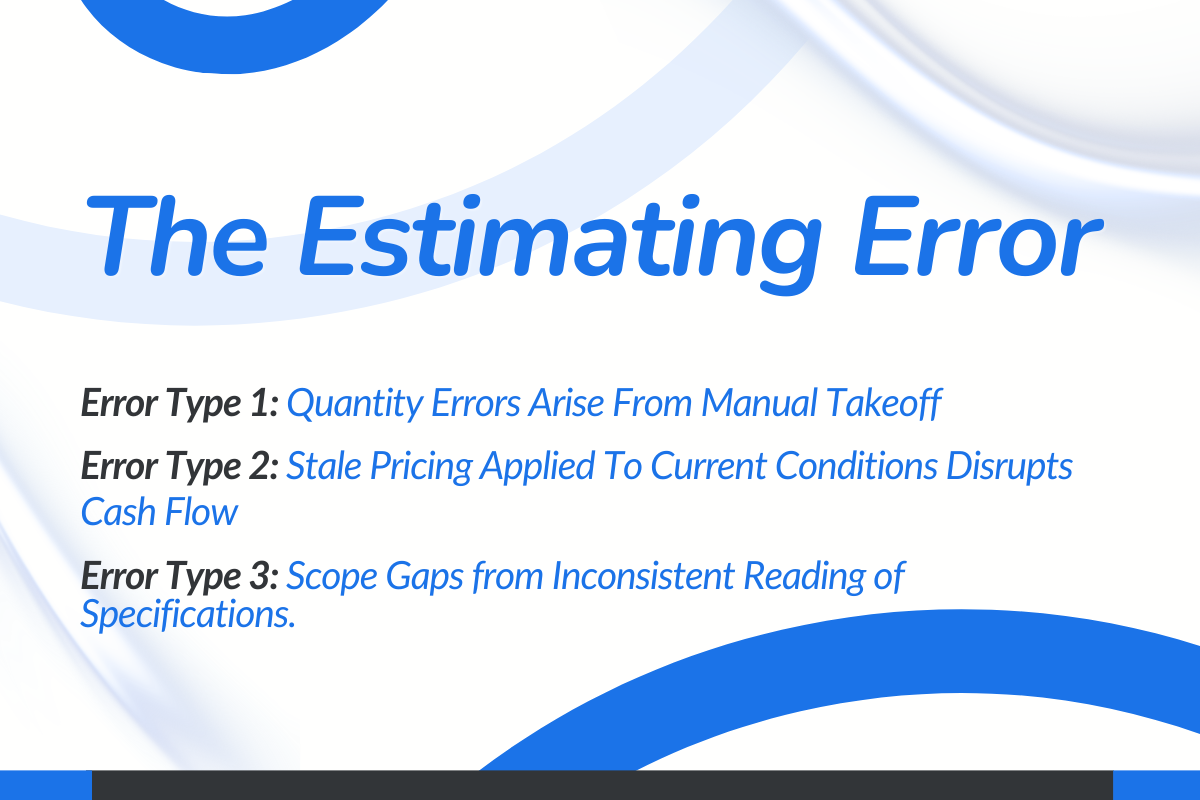
Error Type 1: Quantity Errors Arise From Manual Takeoff
Source of Error: Manual takeoff can overlook complex building layouts, and manual calculation errors can lead to miscalculated material quantities, resulting in cost overruns or material shortages.
Impact: Incorrect quantity estimates can increase project costs, delay procurement, which pushes project timelines further, and reduce profit margins through underbidding. It also leads to missed job opportunities due to overbidding, reducing competitiveness in the future.
Example: A small contractor carries out a manual takeoff for drywall quantities using architectural drawings but misses ceiling height variations in a few rooms.
During construction progress, the project faces a 15% material shortage, forcing the company to purchase additional materials at higher last-minute prices, reducing profit margins.
Error Type 2: Stale Pricing Applied To Current Conditions Disrupts Cash Flow
Source of Error: Small builders operating on manual spreadsheets often rely on outdated pricing lists, which are volatile in nature and change dynamically in a short span.
Impact: The estimates based on the old pricing list lead to a budget shortfall, disrupt cash flow, and shrink profit margins as actual costs exceed the quoted bids.
Example: An estimator from a small construction company created an estimate for a residential house project based on pricing updated four months earlier. When the estimate was approved and the purchase order was placed, the builder had to pay higher market rates, constraining their profit margins.
Error Type 3: Scope Gaps from Inconsistent Reading of Specifications.
Source of error: The MasterFormat, developed by the Construction Specifications Institute, organizes construction specifications into 50 divisions, but estimators can sometimes miss critical requirements when reviewing lengthy project specification documents.
Impact: It can result in unexpected scope gaps in estimates that are identified during construction, leading to cost overruns, disputes, and project delays.
Example: An estimator reviews a large specification package but misses a Division 01 requirement for site safety. When construction work begins, the contractor realizes the missing specification, leading to additional costs and delays in project execution.
These errors do not define an estimator's capability, but are a major gap in their workflow. When manual processes do the heavy lifting, even a small mistake can ripple through the entire project, disrupting cash flow and operations even before a single brick is laid.
The firms winning more construction work today are the ones equipping their teams with AI-powered estimating tools that make the process faster and more reliable.
What AI-Powered Estimating Software Actually Does and Does Not In 2026?
AI-Powered Construction Estimation Software can make the 20-hour takeoff job into a 20-minute task by speeding up takeoff, tracking progress, and running efficient operations.
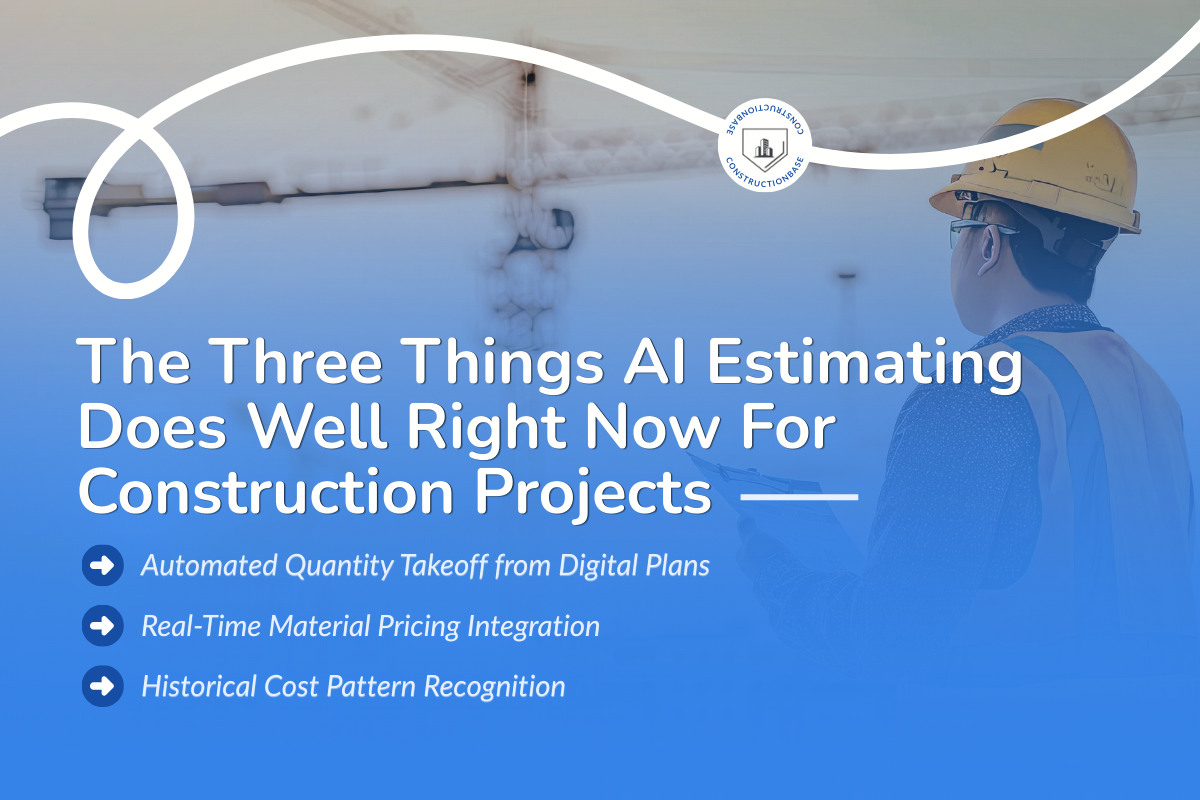
A. The Three Things AI Estimating Does Well Right Now For Construction Projects
1. Automated Quantity Takeoff from Digital Plans
It is a machine-learning-driven tool that captures digital blueprints from several formats (PDF, CAD, or BIM) and instantly measures dimensions to calculate material quantities with high accuracy.
2. Real-Time Material Pricing Integration
The software pulls live vendor pricing to generate accurate cost estimates, helping contractors manage price fluctuations and maintain profitable bids. 67% of the top 100 global contractors use AI for cost estimation
3. Historical Cost Pattern Recognition
AI analyzes past project data, such as labor hours and material costs, to improve estimate accuracy and support better decision-making.
B. The Three Things AI Estimating Cannot Do Yet, and Why This Matters for Small Builders
Let us be honest and acknowledge the limitations of AI usage as it offers tremendous benefits, but limitations exist, too!
1. It cannot read a Spec Book like an experienced estimator
AI is a powerful ally when guided by human estimators. The complex and real-world volatile conditions, such as supply chain disruption or regional shortages, can affect material, labor, pricing, and market trends.
The judgment, risk awareness, and experience of professionals will hold greater value in predicting potential delays and cost implications. Speed and automation offered by AI, relying solely on historical data analysis, fail here.
2. It cannot replace relationship-based pricing
The right estimate does not depend solely on technical calculations. Understanding a client’s budget, needs, past relationships, and mindset often shapes negotiations and helps contractors offer the best value.
AI can assist with data and calculations, but strategic decision-making for relationship-based pricing remains a unique human trait.
3. It cannot catch what is missing from the drawings.
AI systems rely on predefined abbreviations and formats, so they may overlook new symbols or misinterpret unfamiliar blueprint styles.
Experienced estimators interpret contextual cues in drawings to identify missing elements or design errors. Construction software analyzes only the provided drawings, while human estimators can anticipate slopes, soil conditions, and unforeseen site issues through experience.
Six Practical AI Usage Case Studies That Small Builders Are Actually Using in 2026
With a clear picture of what the technology actually does, here are the six specific use cases where small builders are seeing measurable time savings and error reduction.
Case 1: AI Takeoff on Repetitive Residential Plans
The Problem: A small homebuilding firm undertook a project to construct 14 similar single-family homes across three regions on similar plane regions. The Estimators spent 8 to 10 hours manually preparing each estimate. Since all the homes had similar designs, the work was highly repetitive, and even experienced estimators began overlooking details as the process became routine.
How AI helps: AI-powered estimation tools automate measurements, quantity takeoffs, and cost calculations for repetitive tasks. AI ensures consistency and reduces human errors.
Measurable Outcome: Reduced estimation time from 8–10 hours to just a few minutes, while minimizing human error and increasing bidding capacity.
Tool that Helps: AI-driven construction estimating software that generates precise estimates.
Case 2: Automated Material Price Updates Across Active Bids
The Problem: A small commercial general contractor was managing three active bids simultaneously: one submitted last week, one currently under construction, and another scheduled to go out in 10 days.
Suddenly, lumber and steel prices spiked by 8%. Every line item in the supplier list that contains these materials had to be reviewed and updated. The builder only adjusted the current and upcoming bids, relying on intuition that the spike was not significant. It led to underbidding on past projects and shrinking profit margins.
How AI helps: AI integrates with live supplier pricing and automatically updates material costs across all active bids. It flags impacted line items and recalculates estimates in real time.
Measurable Outcome: Helped to maintain healthy margins and kept all active bids aligned to live pricing.
Tool that Helps: A Construction management software with AI capabilities that has integration to live supplier pricing.
Case 3: Absence of Scope Gap Detection
The problem: A small builder needed to review a commercial project of 187 pages of drawings and a 400-page specification package within 2 days. It was not humanly possible to evaluate the entire project, and several essential scope items were overlooked, resulting in costly change orders.
How AI helps: It scans drawings and specifications to identify missing items, inconsistencies, and scope gaps. It highlights risks early so estimators can review and correct them before submission.
Measurable Outcome: More accurate bids and reduced change order mistakes.
Tool that Helps: AI-powered estimating platforms to detect scope gaps and streamline bid accuracy.
Case 4: Historical Cost Benchmarking and Anomaly Detection
The problem: A small builder that keeps a daily log has $18 million in cost data from 40 past projects, but none of it was used to improve the efficiency of current estimates by studying trends to spot anomalies and weak areas. It often leads to lower profit margins.
How AI helps: It analyzes historical project data to identify cost patterns, benchmark pricing, and flag anomalies in new estimates. It highlights where costs deviate from past trends.
Measurable Outcome: Improving efficiency in the bids' accuracy and stronger profit margins for new projects.
Tool that Helps: AI-assisted platforms that leverage past project data for AI-driven cost insights.
Case 5: Proposal Generation and Formatting Automation
The problem: A small construction builder company spends an average of 2.5 hours after completion of an estimate to create client-ready proposals. The admin task is time-consuming and has a risk of transcription errors.
How AI helps: AI automatically transfers data into professional proposals, reducing manual efforts and eliminating transcription errors.
Measurable Outcome: Saves time spent on administrative hours, and proposals are visually impressive and error-free, helping to speed up submission and close deals faster.
A tool that helps: A Construction CRM Software to generate a proposal directly from estimates.
Case 6: Subcontractor Bid Leveling with AI Assistance
The problem: A small general contractor juggles 5 to 8 bids each day by comparing them, which mostly leads to mistakes and slower decision-making, reducing profits.
How AI helps: Automated comparison of scope and cost discrepancy to reduce errors and save time under tightened deadlines.
Tool that Helps: Construction software that automates bid levels and scope comparison for subcontractor quotes.
The Best AI-Powered Construction Software Comparison for Small Builders in 2026
These cases highlight the real value of AI-assisted construction software. The next question is: which tool should you choose, and what will it cost?
To get a resolution to this, let us explore the top AI construction software platforms to stay ahead in the race for winning projects, earning client praise, and achieving smooth business scaling.
1. ConstructionBase
About: A comprehensive all-in-one software solution using advanced AI tools designed for commercial and residential contractors that automates the entire workflow from lead capture to project completion.
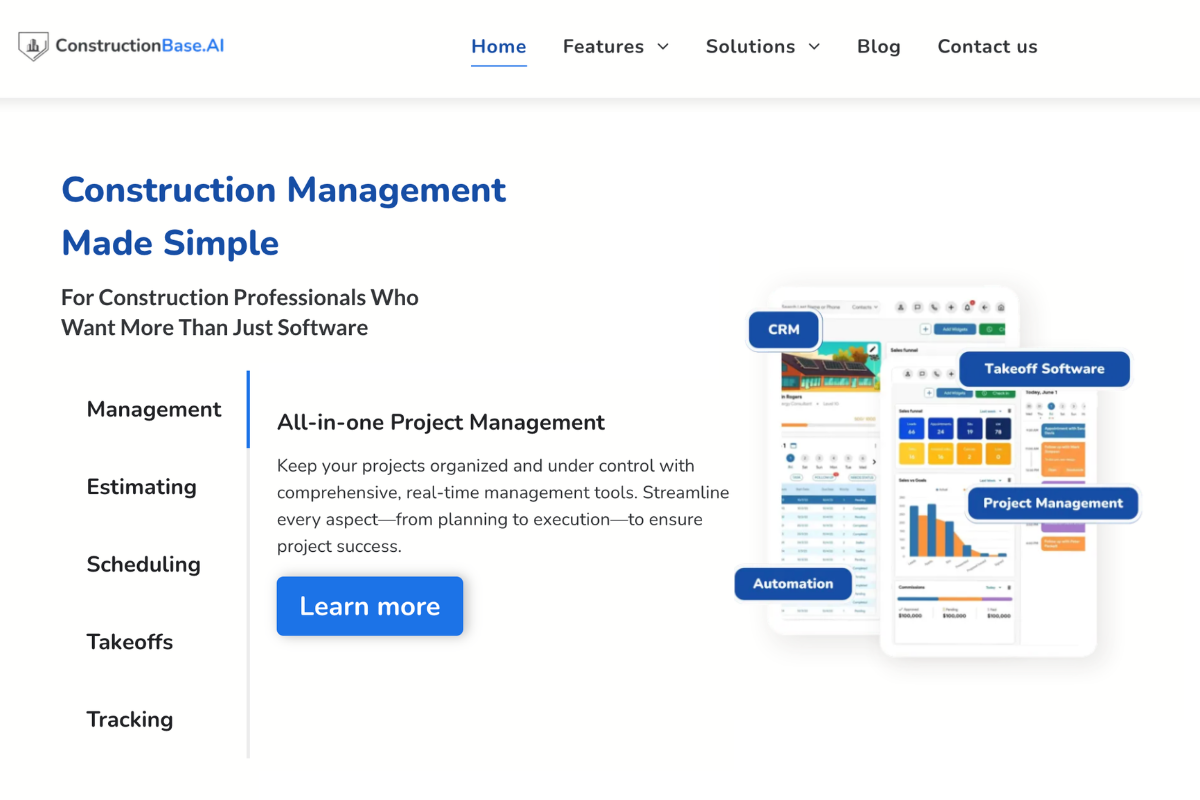
Best for: Small to mid-size firms to automate scheduling, budget, estimation, and material takeoff for optimizing resource allocation, and to accelerate the bidding process.
Key AI Features:
- AI-Powered Job Scheduling: Automatically assigns tasks to technicians based on external conditions such as technician availability, live location, job priority, weather forecasts, and traffic conditions to optimize labor and resource usage.
- Weather Intelligence Forecasting: Advanced features like HailTrace can even predict hailstorms, helping teams adjust schedules and protect projects from weather-related disruptions.
- Predictive Analysis: Uses AI to analyze project progress and external market conditions to forecast potential delays such as labor shortages, material supply issues, or scheduling conflicts for proactive actions.
- Automated Material Takeoff: AI technology reads digital blueprints and construction drawings to generate accurate material calculations to streamline procurement.
- Real-Time Updates with Smart Alerts: Delivers instant alerts about resource shortages, safety concerns, labor challenges, and other project disruptions with real-time visibility into project progress to make informed decisions.
- Centralized Document Storage: Securely stores and manages contracts, project documents, blueprints, and compliance records in one centralized platform with version control accessible by all team members anytime and anywhere using a mobile app.
- Precise Estimates and AI-Driven Bidding: AI-powered tools calculate material and labor costs using real-time pricing data to create accurate, competitive, and profitable bids while minimizing the risk of cost overruns.
- Automated Lead Capture and Engagement: Captures leads from multiple channels and uses automated follow-up workflows to keep potential prospects engaged and nurture leads until conversion to confirmed jobs.
Pricing: No pricing plans are disclosed publicly. You need to connect with the sales team for personalized quotes that fit your workflow.
2. Buildxact
About: It is a cloud-based software designed for general contractors in the construction industry to streamline operations using AI-powered tools called 'Blu' for takeoff, estimation, and project schedules.
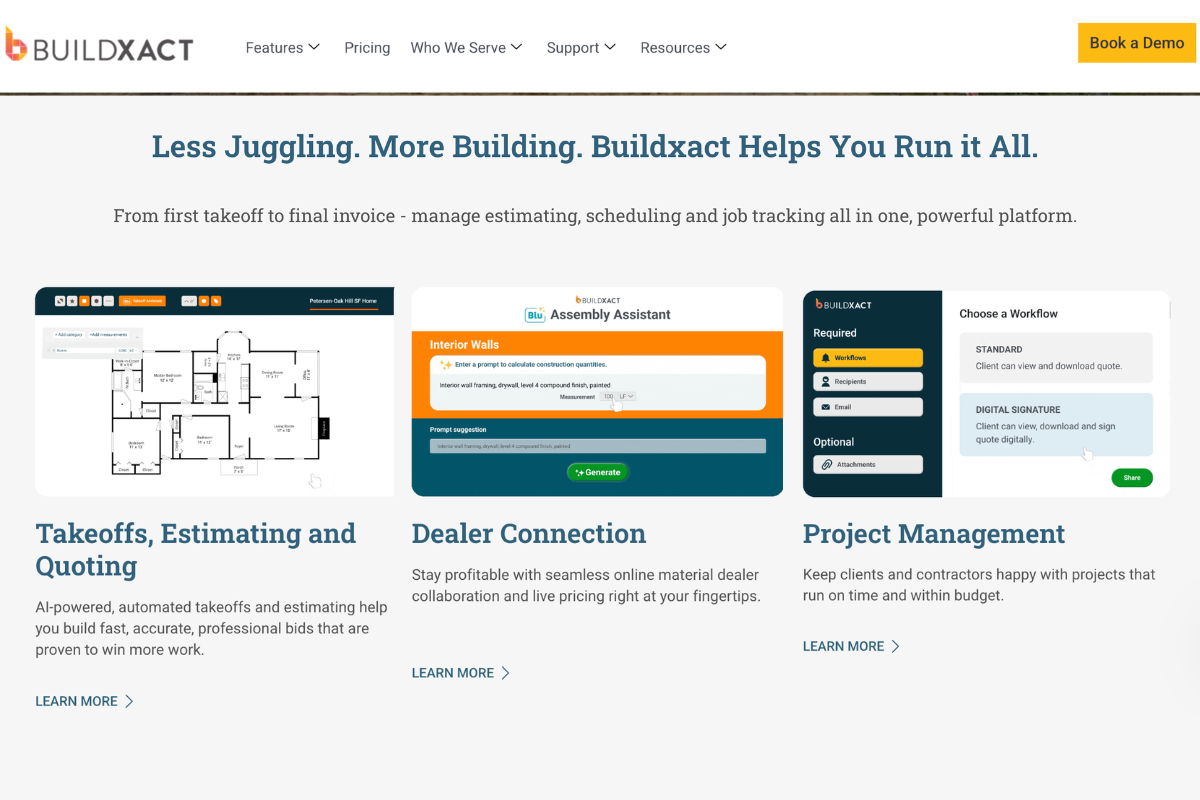
Best for: Ideal for small to mid-sized residential builders, general contractors, and remodelers who need to automate takeoff and project management.
Key AI Features:
- Material Takeoff Process: Creates structural assemblies for projects and automatically measures material quantities from digital plans.
- Professional Estimates and Proposals: Creates instant, client-ready proposals using built-in templates and real-time supplier price lists for accurate estimates using the AI tool Blu Estimate Reviewer, which also scans and double-checks estimates and bids to identify potential errors and prevent costly inaccuracies.
- Client Portal: Allows customers to view quotes, proposals, and invoices while also sending messages directly to construction teams through the platform to keep clients informed throughout the project lifecycle.
- AI-Powered Lead Management: Tracks and manages prospective projects from initial inquiries through automated follow-ups to nurture leads with efficiency that increases chances to convert potential opportunities into confirmed jobs.
Pricing: Offers monthly and annual pricing across three plan tiers, with a 15% discount on annual subscriptions.
- Foundation: $199
- Pro: $399
- Master: $599
3. Togal.AI
About: It is an artificial intelligence-based, cloud-based digital platform founded in 2019, designed for construction projects to automate the material takeoff and estimation process using advanced machine learning algorithms.
Best for: The platform is ideal for construction estimators, general contractors, and subcontractors looking to automate and accelerate the takeoff process to increase bidding capacity and accuracy.
Key AI Features:
- AI-Powered Drawing Analysis: It uses artificial intelligence to automatically interpret construction drawings and blueprints, identifying structural elements that speed up the material takeoff process.
- Material Takeoff Automation: Extracts measurements directly from digital plans and generates accurate cost estimates for materials, labor, and equipment using live pricing data to improve estimation accuracy and profitability.
- Safety Detection Alerts: Machine learning algorithms scan blueprint images to identify potential issues, errors, and ambiguities that could lead to safety risks or incorrect bids.
- Cloud-Based Collaboration: Allows teams to work on takeoffs and estimates with a real-time communication portal through a cloud-based platform, improving project coordination.
- Accelerated Bidding Process: Automates takeoffs and calculations so that contractors can prepare more bids in less time and increase time spent on winning project deals.
Pricing: It offers a subscription model based on the number of users, with options for monthly or annual billing.
- Free Trial: 7-day trial period
- Monthly: $299 per user/month (Full access to AI takeoff tools.)
4. ALICE Technologies

About: It is an AI-driven scheduling and planning solution for construction projects designed for efficient planning, optimized resource allocation, and smoother project execution.
Best for: The platform is suitable for large-scale construction projects that need AI optimization for bidding and construction estimate plan executions.
Key AI Features:
- Optimized Schedules: Artificial Intelligence to generate optimized construction project schedules with an efficient sequence of tasks.
- Automated Cost Estimates: Uses labor, equipment, and material quantities to determine cost projections accurately and identifies hidden costs or overruns that can bring profit margin issues.
- Optimal Resource Usage: The platform allocates labor, equipment, and materials across the project as per requirement for drastically reducing wastage and overspending.
- BIM and Project Data Integration: 3D modeling with live project management, GIS, and cost data with a single source of truth to reduce risks and increase efficiency.
Pricing: It offers custom pricing based on the type and size of your construction projects, available upon request.
5. OpenSpace

About: It is an AI-powered tool for construction projects using that enables automated capture of images from construction sites for a digital record of the job site and converts them into visual intelligence to monitor work and reduce disputes.
Best for: It is a highly scalable platform with advanced AI-powered imagery, ideal for companies that want to capture site images and create 360-degree views of construction sites for a Google Street View–like experience for all construction projects.
Key AI Features:
- AI-Powered Reality Capture: It uses 360° cameras, drones, and laser scanners to capture jobsite imagery and converts it into digital site records using spatial AI for floor plans and other structures.
- Cost and Schedule Tracking: OpenSpace uses AI tools to convert site imagery into measurable data that project managers can use to detect cost overruns or delays.
- On-Field Note Updates: It allows instant pinning of issues through AI usage to keep all team members updated.
Pricing: The Core and Enterprise plans follow a custom pricing model. You need to contact the sales team for a personalized quote based on their requirements.
| AI Estimating Tool | Standout Feature | Ease of Use |
|---|---|---|
| ConstructionBase | All-in-one workflow that combines AI for takeoff, estimation, cost forecasting, and competitive bidding. | User-friendly. |
| Buildxact | Special AI feature 'Blu' that automates estimation and takeoff for better project planning. | Easy to learn with a guided workflow |
| Toglai.ai | Automated Takeoff process using uploaded blueprints within seconds. | Moderate/High |
| Alice Technologies | Generative AI capabilities provide 3D designs and data-driven insights for better project planning. | Moderate |
| OpenSpace | AI-powered site capture in a 360-degree view with analytics for project managers to detect scope gaps for improving cost accuracy. | A steeper learning curve, with initial training required. |
AI is leading the way in helping contractors spot issues before they spiral out of control during project execution. By adopting the right AI-driven software, construction teams can work smarter.
The Implementation Reality: What Inputs Does an AI-Estimating Software Actually Require from Small Construction Builder Teams?
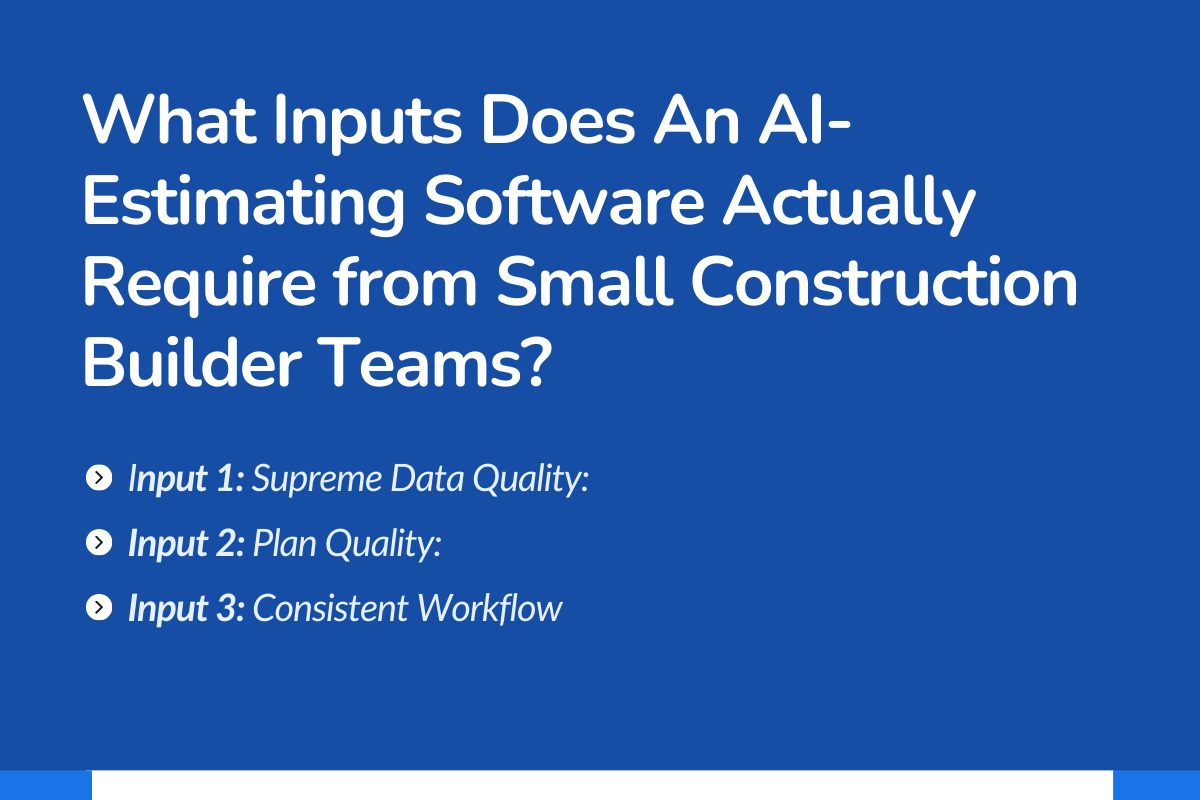
Artificial Intelligence cannot deliver meaningful results unless it is powered by the right data, inputs, and instructions.
For small-sized builders, the shift from manual workflows to digital systems is already a major step forward. However, moving from digitization to an AI-driven workflow requires the right input to unlock real value. Here is what the software needs from you:
Input 1: Supreme Data Quality:
- AI systems rely on historical data to detect trends and patterns to generate data-driven insights.
- The right input of past job cost data, labor hours, material usage, and timelines must be properly stored to derive better data-driven insights based on historical data.
Input 2: Plan Quality:
- AI takeoff tools use high-resolution digital plans to accurately detect building elements such as walls, floor areas, and material quantities.
- Hand-drawn or poorly scanned drawings can hinder the precision and clarity of AI-powered measurements.
Input 3: Consistent Workflow
- Construction project teams must move beyond the spreadsheet era and adopt AI platforms as part of their daily workflows.
- They need to address initial challenges within the system rather than reverting to manual processes.
Timeline to Adopt :
AI is not a plug-and-play button; it needs patience and consistent usage to generate meaningful output. Let us get an insight into the timeline you must invest in if you have an AI-powered assistant:
- Weeks 1–3 – Learning Phase: This stage involves initial setup, platform onboarding, and adjustments to the new AI-driven workflow as teams familiarize themselves with the system.
- Weeks 4–8 – Adaptation and Issue Resolution: Teams gradually adapt to the AI workflow while identifying and resolving early operational hiccups to ensure smoother day-to-day usage.
- Weeks 9–10 – Efficiency Gains: The platform begins delivering measurable cost and time savings, while improving collaboration between office and field workers to streamline project workflows.
- Weeks 11–12 – Optimization: With consistent usage, the system improves estimation accuracy and precision, increases bidding capacity, and enhances the overall project win rate.
Conclusion
AI-powered tools simplify construction estimating for small builders by saving time on takeoffs, delivering more precise estimates, and allowing teams to bid on more projects with an elevated level of confidence.
The best contractors in the construction industry are now using AI as an assistant to automate measurements, generate estimates, and spot design issues before they start digging into the ground.
AI can't replace skilled tradespeople on construction sites, but it can deliver greater accuracy and customized estimates for every project, helping contractors bid better and safeguard profitability.
Quit burning time, effort, and money on outdated estimating processes.
Experience how ConstructionBase can boost your estimation accuracy with greater efficiency and precision. Book a Demo today and let our exceptional support team guide you through every step.
Frequently Asked Questions (FAQs)
1. Is AI construction estimating software accurate enough to trust for a real bid?
The construction software with AI-enabled capabilities has increased accuracy in takeoffs, allowing for accurate and faster bids. Automated takeoffs using drone or satellite technology, combined with real-time pricing, make bids more precise and relatable. However, for very complex or non-standard site conditions, human expertise for a quick overview is still necessary before final bid submission.
2. How much time does AI estimating actually save for small construction professionals?
AI estimation construction software can save professionals hours or even several days per project by automating takeoffs, material calculations, and cost estimates, which can now be completed in minutes with fewer errors. This enables construction professionals to increase bid capacity and execute more projects each day.
3. What is the minimum revenue size where AI estimating software makes financial sense?
There is no minimal revenue size prerequisite for AI-Estimatiom Software as it helps all construction projects to gain accuracy in takeoff and enable faster bidding, which helps the project managers scale faster.
4. Can AI estimating software work with hand-drawn or older plan sets?
Advanced AI-powered tools for Construction Estimation Software use optical Character Recognition and machine learning to interpret and extract estimated quantities from older handwritten documents. The accuracy in these estimations can be lower than that of digital blueprints.
5. Do I need a dedicated estimator in the staff team to use AI estimating software effectively?
AI-powered tools automate repetitive tasks and reduce delays in estimation. They assist in bid preparation and cost calculation using automated takeoff data, speeding up the process with precision. However, human expertise for oversight cannot be replaced. Project management, which previously required multiple estimators, can function efficiently with just one or two team members when supported by AI-powered digital tools for high-volume project estimates.
6. How do I know if my current estimating errors are costing me more than the software would cost?
If your current estimation process results in miscalculated materials, inconsistent labor costs, failure to accommodate change orders (leading to rework), higher indirect costs overlooked in estimates, and lost time that delays projects and harms your reputation, it can significantly impact revenues and profit margins. If your profit margins are shrinking and the costs you bear are likely to exceed the price of software designed to reduce these inefficiencies, then it indicates that you are paying more than the software would cost annually.
Have questions or need personalized advice?
Talk to an Expert Today and let our construction specialists guide you to success.
Related Posts
Building Construction Project Software: Key Integration Points You’re Missing