Contractors, including smaller businesses, don't lose bids because of a lack of skill; they lose because projects move faster than traditional estimating can keep pace.
With prices shifting weekly, labor changing overnight, and material and labor costs factored in, clients now expect accurate, confident numbers before work begins.
Predictive estimating provides faster, more precise, data-driven figures and detailed estimates that account for job-site conditions, with features that outperform spreadsheets.
Data-driven estimating helps eliminate guesswork and ensures every project begins with a reliable cost baseline.
Best Construction Estimating Software That Predictively Improves Win Rates
Not all estimating tools deliver the same results. While basic software digitizes spreadsheets, predictive estimating software improves accuracy, speed, and confidence by using live data and proven cost logic.
By recognizing patterns and adapting to changing conditions, these tools help contractors manage multiple bids, stay consistent, and submit competitive proposals without sacrificing margins.
In this blog, you’ll learn how predictive estimating software works, why traditional estimating methods fall short, and how data-driven estimates directly improve bid accuracy and win rates.
We’ll also break down the features that matter most, common mistakes to avoid, and how top contractors are using predictive tools to stay ahead.
Key Takeaways
- Contractors lose more bids because their estimates are late or inaccurate, not because their prices are too high.
- Predictive estimating replaces guesswork with data-driven clarity, improving trust and proposal quality.
- Construction estimating software increases accuracy, speed, and consistency, helping teams win more work.
- Businesses that modernize now stay ahead of competitors who still rely on manual estimating.
- Predictive estimating is evolving quickly, becoming a long-term strategic advantage.
Eager to See How Predictive Estimating Improves Win Rates?
See how data-driven, predictive estimates help contractors respond faster, reduce risk, and submit more confident bids. Take a closer look at how modern estimating workflows help you stay ahead.
Why Accurate Estimates Matter More Than Ever in Today's Construction Market?
Construction projects today move faster, face tighter margins, and operate under constant cost pressure. Labor availability shifts, material prices fluctuate, and clients expect firm numbers earlier—making even small estimating errors costly.
However, predictive estimating helps contractors price work with confidence by adapting to real-world changes instead of relying on static estimates.
For teams managing multiple projects, this accuracy becomes a competitive advantage, enabling them to win bids driven by trust and reliability, not just speed.
1. Slim Margins, Fast Turnarounds: The New Normal in Construction Bidding
The industry isn't slowing down for anyone. Labor shortages, rising material costs, and compressed deadlines have made margin control incredibly difficult.
Predictive estimating helps contractors stay up to date by absorbing real-time cost changes, including subcontractor management, and automatically adjusting bid values.
Instead of reacting to volatility like with other software, you stay ahead of it. The more dynamic your pricing model, the stronger your bid becomes.
2. Manual Spreadsheets = Hidden Errors That Destroy Win Rates
Spreadsheets introduce hidden risks into the estimating process. Formulas break, tabs become inconsistent, and minor errors can quietly impact entire bids. Formulas don't update. Tabs become inconsistent.
One copy-paste error can throw your entire bid off without you noticing until it's too late. Predictive estimating software, along with support services, removes that uncertainty by validating data as you go and catching mistakes automatically before they become costly.
3. Inconsistent Pricing Hurts Trust
If your pricing changes from one project to another simply because different people prepared the estimate, clients notice.
Predictive estimating fixes this problem by standardizing how numbers are generated, formatted, and delivered.
This consistency builds trust, and trust is one of the biggest reasons clients choose one contractor over another.
A smooth transition becomes far more achievable when estimating software is built with a clear, intuitive user interface that supports real-world workflows.
What Is Predictive Estimating?
Predictive estimating occurs when construction experience is combined with automation, analytics, and real-time project intelligence, enhancing project planning throughout the estimating process.
Instead of relying solely on estimators' intuition, the software pulls data from previous projects, market trends, material vendors, labor history, and regional fluctuations.
It becomes a constantly learning system that helps you produce more accurate estimates every time you bid. And unlike spreadsheets that freeze in time, predictive estimating grows smarter with every project you complete.
1. From Static Templates To Live Data-Driven Estimates
Your templates aren't just templates anymore; they're dynamic, constantly refreshed, and synced directly with vendor pricing, cost changes, and inflation indicators.
The moment the market shifts, your estimates shift with it, too. That is something spreadsheets will never be able to do.
2. Using Past Project Data to Improve Bid Accuracy
Imagine if your estimates automatically got more accurate every time you completed a job. That's precisely what predictive estimating does.
It studies your labor hours, waste factors, job types, subcontractor performance, production rates, and cost history. The more projects you complete, the sharper your estimates become.
3. Automated Error Detection That Saves You Time & Rework
You know that sinking feeling when you discover a pricing mistake, often due to common mistakes, after the proposal has been submitted?
Predictive estimating removes that anxiety entirely, allowing you to save time. The system flags missing costs, incorrect labor hours, and odd discrepancies before they ever reach your client.
Already curious how software eliminates spreadsheet headaches? Check this out: Construction Estimating: From Manual Spreadsheets to Automation
How Construction Estimating Software Improves Win Rates?
Winning bids isn't magic, it's simply being better, faster, and more accurate than the competitors bidding the same job. Predictive estimating gives you that edge before the proposal even leaves your desk, thanks to its user-friendly interface.
As an all-in-one solution, predictive estimating software streamlines workflows, reduces errors, and seamlessly connects different project phases. When your numbers are more precise and your turnaround time is shorter, you immediately stand out.
1. Faster Estimates = Faster Responses = More Closed Bids
General contractors and residential builders, including smaller businesses, who switch to automated estimating often say the same thing: "We submit twice as fast now."
When the estimate generator uses digital plans, templates, and automation, your turnaround time and your competitive edge improve.
Compared to other tools, modern construction estimating software offers additional features and functionalities that further enhance efficiency.
2. Standardized Pricing That Builds Client Confidence
When every estimate you produce looks professional and follows the same structure, clients develop confidence in your process.
They feel like they're partnering with someone who understands construction management, not someone guessing their way through a spreadsheet.
3. Auto-Updating Material Costs Reduce Underpricing Risk
Materials fluctuate constantly. Your estimating software should keep up with that without requiring you to check prices manually. Auto-updating cost databases protect you from underpricing, missed markups, or lost margins.
4. More Accurate Labor Forecasting Prevents Budget Blowouts
Labor is one of the most significant variables and the hardest to control. Predictive tools analyze your past labor hours to forecast durations more realistically, reducing surprises later.
What are the Features That Make Predictive Estimating a Game-Changer?
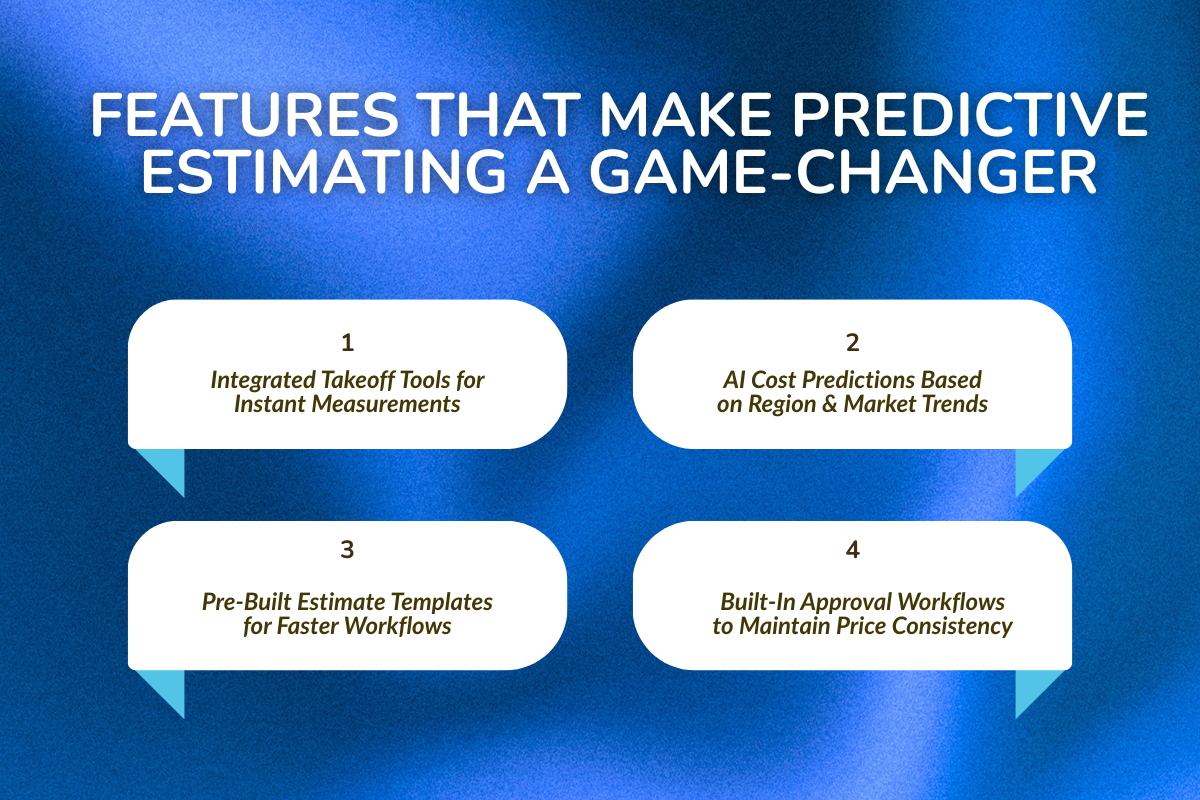
As construction management grows more complex, estimating software must deliver comprehensive features that strengthen accuracy from the first takeoff to the final invoice.
As a business grows, predictive estimating software offers enhanced features and capabilities to support larger, more complex operations.
Now, let's take a look at the must-have features:
1. Integrated Takeoff Tools for Instant Measurements
With linear takeoff, 2D takeoff, and quantity takeoff integrated directly into your estimate, you never need to switch between tools or copy data manually again.
Prebuilt assemblies automatically generate itemized material lists, saving time and improving efficiency in the estimating process. This seamless integration saves time and reduces human error, particularly in job management and scheduling tasks.
2. AI Cost Predictions Based on Region & Market Trends
AI evaluates regional inflation, vendor costs, seasonal labor availability, and market shifts, enabling contractors to create more precise forecasts than spreadsheets alone.
3. Prebuilt Estimate Templates for Faster Workflows
Instead of rebuilding layouts from scratch, estimators rely on customizable templates that match their workflow.
These templates shorten bid preparation time and ensure consistent project costs across all proposals, and a free version may help you test their effectiveness.
4. Built-In Approval Workflows to Maintain Price Consistency
Teams with multiple estimators benefit the most here. Approval workflows prevent version conflicts, pricing errors, and inconsistencies, especially when handling multiple bids simultaneously.
Spreadsheet vs. Predictive Estimating Software: A Side-by-Side Comparison
Here's how spreadsheets stack up against predictive estimating software:
| Feature / Factor | Spreadsheets | Predictive Estimating Software |
|---|---|---|
| Accuracy | High risk of errors due to formulas, manual entry, and outdated templates | Machine-calculated precision with automated error detection and live cost syncing |
| Speed | Slow, repetitive copy-paste work; takes hours to revise | Automated workflows deliver estimates in minutes, not days |
| Pricing Updates | Must be updated manually; often outdated | Real-time cost database updates keep pricing accurate and competitive |
| Collaboration | Email attachments, duplicated files, and version confusion | Cloud-based partnership with a single shared source of truth |
| Scalability | Breaks down as teams grow or handle multiple projects | Built for various estimators, complex takeoffs, and large bid pipelines |
| Professional Output | Inconsistent proposal formatting | Clean, standardized client-ready estimate and proposal generation |
| Risk Exposure | High, one mistake impacts the entire bid | Low, automated validation catches inconsistencies instantly |
As discussed in Why Construction Companies Need Management Software, relying solely on spreadsheet-based estimating is no longer sufficient to stay competitive.
How to Choose the Right Construction Estimating Software?
Choosing the best construction estimating software isn't about picking the tool with the longest feature list; it's about choosing the one that feels natural for your workflow.
If the platform doesn't align with how you estimate today, your team won't enjoy using it, and adoption will drop instantly.
The right software simplifies estimating, integrates with CRM and accounting tools, and helps your team deliver faster, precise, professional estimates without overwhelming them.
1. Identify Your Estimating Style: Simple Bids or Complex Takeoffs?
If your projects require detailed assemblies, digital plans, or heavy takeoff work, you'll need construction estimating tools that support advanced workflows. If your bids are simpler, an estimate generator and customizable templates may be enough.
2. Ensure It Integrates With Project Management & Accounting Software
Seamless integration is crucial for maintaining consistency across estimating, scheduling, job management, and invoicing.
When data flows freely between estimating and execution, you avoid duplicate entry and reduce mistakes.
3. Look for AI-Powered Predictive Features
Some tools only digitize your existing process. Others, especially predictive estimating software, fundamentally improve accuracy through forecasting, risk analysis, and cost database automation.
4. Evaluate Training & Adoption: Can Your Team Learn It Fast?
A steep learning curve slows down adoption. Choose a solution with a user-friendly interface that feels natural to your estimators. Modern tools also support unlimited users, so your entire team can collaborate without extra fees.
Implementation Blueprint: How to Move From Spreadsheets to Predictive Estimates
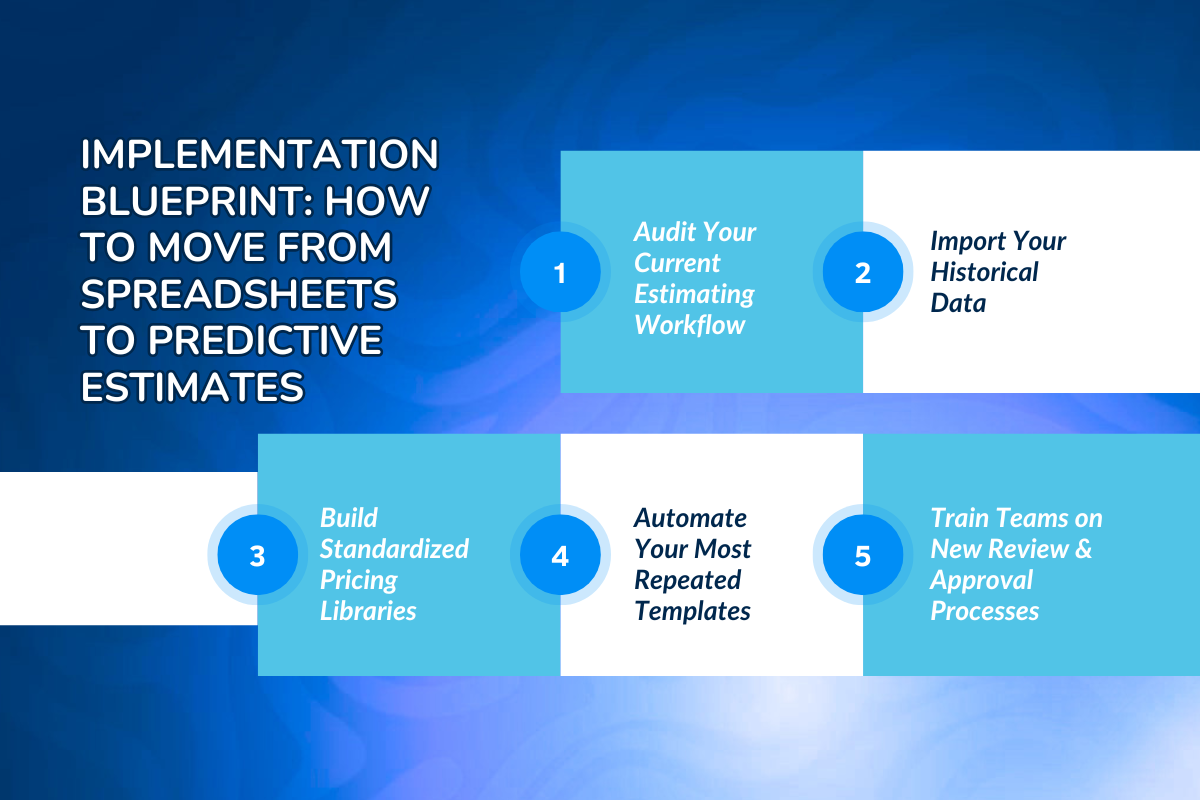
Switching from spreadsheets to modern estimating software doesn't need to feel intimidating, especially when you follow a simple roadmap.
The transition becomes smoother when your team knows what to expect and understands how the new system fits into your daily work. By taking small, strategic steps, you set everyone up for success while building long-term estimating accuracy and efficiency.
Step 1: Audit Your Current Estimating Workflow
Begin by identifying where your estimating process slows down. Look for issues like manual data entry, inconsistent pricing, outdated templates, or poor cost visibility. This clarity helps you know exactly what needs to change before adopting new software.
Step 2: Import Your Historical Data
Past estimates are valuable learning tools. Labor hours, material costs, and completed project data provide a strong baseline for future bids.
Importing this data allows predictive estimating software to build accuracy from real results, not assumptions.
Step 3: Build Standardized Pricing Libraries
Standardized pricing libraries ensure that every estimator uses the same numbers. Centralized labor rates, material costs, and assemblies reduce inconsistencies across bids. This becomes especially important as teams grow or handle multiple projects.
Step 4: Automate Your Most Repeated Templates
Automating frequently used templates removes repetitive setup work. It speeds up bid preparation and ensures proposals stay consistent and professional. Over time, this significantly reduces turnaround time without compromising accuracy.
Step 5: Train Teams on New Review and Approval Processes
Adoption succeeds when teams understand the process. Training estimators on review and approval workflows reduces last-minute errors and builds confidence. Clear processes keep estimating organized as the business scales.
How Top Contractors Are Using Predictive Estimating to Win More Bids?
Contractors who consistently win high-value projects don't just estimate faster; they estimate smarter. They use predictive tools to catch price risks early, understand how labor productivity shifts across project types, and respond quickly to opportunities before competitors even finish their first takeoff.
When software alerts you to cost variances, highlights inconsistencies, or suggests adjustments based on past wins, you're suddenly estimating with far more control.
This improvement compounds over time, turning your estimating process into a genuine competitive advantage.
If you want to see how top-performing teams speed up their bid process even further, this guide is worth reading: Construction Estimating Software: Cutting Bid Prep Time in Half.
The Future of Estimating: AI, Real-Time Bidding & Predictive Forecasting
AI-driven estimating software is reshaping how construction estimating works. Predictive forecasting, automated bid pipelines, and intelligent cost analysis are quickly becoming standard features in the best construction estimating software.
Soon, estimating tools will recommend markups, forecast win probability, and generate complete bid packages automatically, helping contractors respond faster and price more strategically across multiple projects.
In a Nutshell
Predictive estimating is transforming construction estimating from a manual task into a strategic advantage.
Contractors who adopt modern estimating software gain more accurate estimates, faster workflows, and better control over project costs. Those who rely on outdated tools risk falling behind as the construction industry continues to evolve.
Why ConstructionBase?
ConstructionBase combines predictive accuracy, real-time cost updates, and team collaboration into a single construction estimating platform built for modern construction teams.
It fits naturally into modern estimating workflows by replacing fragmented tools with a single, connected system built for accuracy and speed.
Together, these capabilities help contractors estimate faster, reduce errors, and win more work with confidence.
Book a demo and experience predictive estimating in action.
FAQs
1. Is construction estimating software suitable for general contractors and residential builders?
Yes, ConstructionBase is designed for general contractors, residential builders, and construction professionals managing multiple projects, offering scalable estimating tools that adapt as a construction business grows.
2. Can ConstructionBase handle construction cost analysis from estimate to final invoice?
ConstructionBase tracks construction costs from the initial estimate through execution and the final invoice, helping teams maintain cost visibility and reduce errors across the entire estimating process.
3. Does the software support bid management and subcontractor comparison?
Yes, built-in bid management tools enable teams to compare subcontractor quotes, manage bid packages, and evaluate cost elements within a single centralized estimating solution.
4. How does estimating software improve profitability in construction projects?
Construction estimating software reduces rework, prevents underpricing, improves labor cost forecasting, and supports data-driven estimating—helping contractors protect margins and improve win rates.
5. How does ConstructionBase support construction management beyond estimating?
ConstructionBase integrates estimating with job management, project planning, scheduling, and accounting software, creating a seamless workflow from bid to project closeout with a reliable internet connection.
Have questions or need personalized advice?
Talk to an Expert Today and let our construction specialists guide you to success.
Related Posts
Building Construction Project Software: Key Integration Points You’re Missing