Here’s a staggering fact for any construction professional: A landmark study by McKinsey revealed a shocking reality in the construction industry: large-scale construction projects run over budget by an average of 80% and are delivered 20 months behind schedule. This isn't just a minor issue; it's a systemic failure, and it almost always begins with the initial construction estimating process.
For a construction business, relying on manual spreadsheets for complex cost estimation is like navigating a minefield. A single formula error in your labor cost calculations or an outdated price for construction materials can turn a competitive bid into a massive loss.
This is why accurate construction estimating isn't just a preliminary step; it's the foundation of your entire project management and profitability. Let's explore the transformation from manual guesswork to data-driven estimating, demonstrating how modern construction estimating software helps you generate accurate cost estimates to protect your margins and secure the right jobs.
Data-Driven Construction Estimating: How Software Creates Detailed Estimates for Your Bidding Process
For construction professionals, the estimating process is a massive challenge.
General contractors need accurate cost estimates to manage project costs. However, manual methods for preparing construction estimates for complex projects are slow and prone to error.
This is where construction estimating software changes the game. It helps professional estimators analyze the project scope, perform quantity takeoff, and deliver precise estimates for a winning competitive bid.
Key Takeaways
- Manual spreadsheets lead to costly bidding errors, project delays, and lost profits.
- Software generates accurate estimates by utilizing central cost data, digital takeoffs, and standard proposals.
- Automation delivers real ROI by increasing bid speed, raising win rates, and protecting profits.
- The future is AI, which uses your historical data to predict financial risks, not just automate tasks.
Boost Accuracy. Bid Faster. Win More.
Experience how automated estimating helps you bid faster, win more projects, and protect profit margins. Explore the platform today.
Why Manual Construction Estimating Fails (And How Software Fixes Cost Estimation)
Before you can fix a problem, you have to diagnose it. For many in the construction industry, the "spreadsheet ceiling" is a painful reality that they face every day.
For decades, general contractors and professional estimators have leaned on spreadsheets to prepare construction estimates. While powerful, this manual estimating process is now a critical bottleneck that limits a construction business's ability to win profitably.
This "spreadsheet ceiling" isn't a single issue. It's a combination of three critical business pains that sabotage your bidding process, strain your team, and quietly erode your profits.
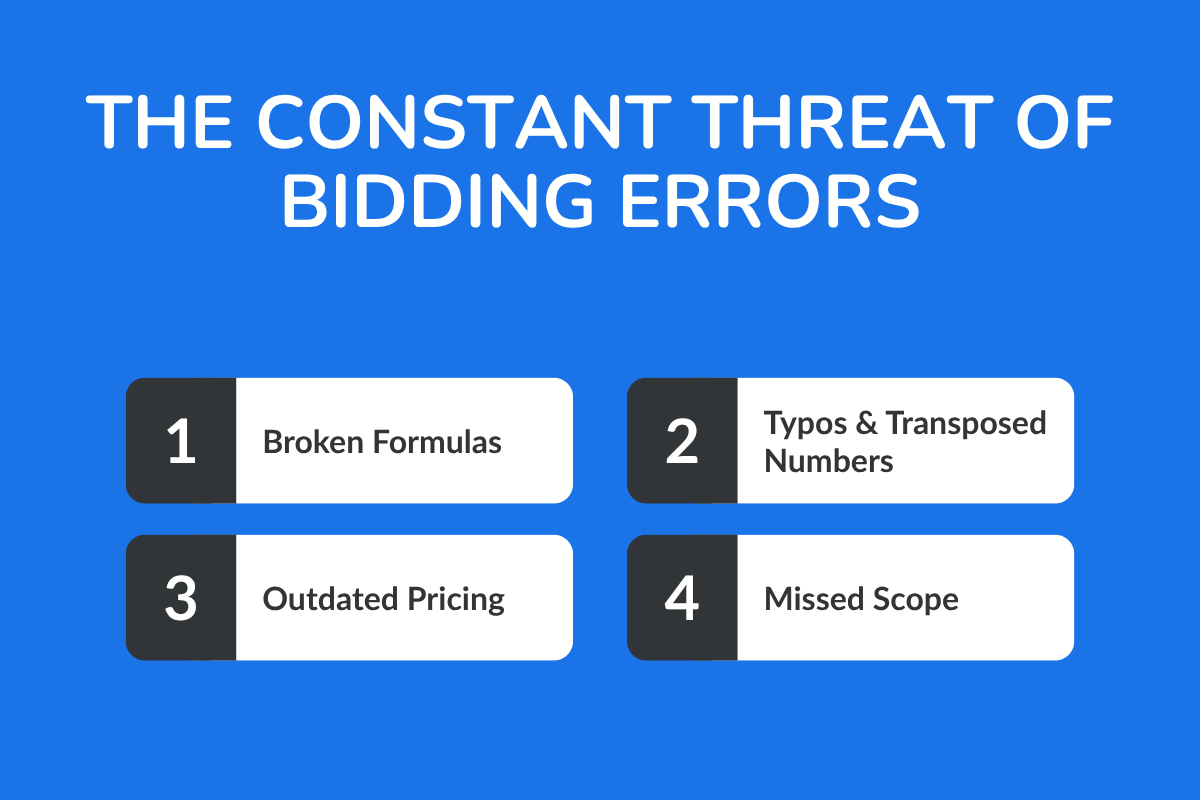
1. The Constant Threat of Bidding Errors
In construction cost estimating, precision is everything. A manual spreadsheet is a minefield for small mistakes that have massive financial consequences.
- Broken Formulas: We've all seen it. A construction estimator adds a new section for indirect costs, but the SUM formula for the total project cost doesn't update to include the new rows.
- Or worse, a cell is deleted, and a critical calculation returns a #REF! error that goes unnoticed. This single, tiny mistake can lead to under-bidding a construction project by thousands.
- Typos & Transposed Numbers: When you’re manually keying in data for hours, mistakes are inevitable. A senior estimator, working fast to meet a deadline, keys in 2,500 units for a fixture instead of 5,200.
- This "invisible" mistake won't be caught until the procurement team tries to order the construction materials, and by then, the budget is already set.
- Outdated Pricing: Spreadsheets are data silos, completely disconnected from reality. The price list for lumber or copper you’re using might be three months old.
- During that time, market trends have shifted, and material costs have increased by 15%. You submit a competitive bid based on outdated data, win the job, and instantly erode your entire profit margin.
- Missed Scope: The cost estimation process requires a comprehensive understanding of all construction documents. When you're cross-referencing a 50-tab spreadsheet with a 200-page set of blueprints, it’s far too easy to forget a line item.
- It’s often the "soft" required costs, such as permits, waste removal, or specific insurance coverage, that get overlooked. The project owner isn't going to pay for them later, so that cost comes directly out of your pocket.
Having problems with bidding? Check out this automated bidding software!
2. Critical Slowdowns in the Estimating Process
Your most valuable asset is your team's time. A manual construction estimating process doesn't take it into account.
- Tedious Takeoffs: The first step in most estimates, the quantity takeoff, is a notorious bottleneck.
- A manual process forces your most experienced (and highest-paid) estimators to spend their days as data-entry clerks, manually tracing blueprints or PDFs with a mouse.
- This represents a significant waste of high-level talent that could be leveraged for cost analysis or strategy development.
- Repetitive Data Entry: After that tedious takeoff, what's next? Manually keying every single number into the spreadsheet. This repetition, for labor cost calculations, unit cost analysis, and material lists, is not just slow; it's the prime opportunity for the typos and errors we just discussed.
- A Hard Cap on Bidding: This inefficiency creates a hard cap on your bid volume. Your team simply doesn't have the hours to respond to every bid invitation. You’re forced to pass on potentially great projects, limiting your growth.
3. Collaboration, Chaos, and Version Control Issues
In project management, a "single source of truth" is essential. Manual spreadsheets make this impossible.
- No Single Source of Truth: This is the pain every team knows. The project manager has Bid_v3.xlsx, the senior estimator has Bid_v3_Final.xlsx, and an executive emails Bid_v3_Final_JOHN-EDITS.xlsx five minutes before the deadline. Which one is correct?
- Wasted Time: Teams waste precious hours trying to reconcile which file has the latest construction specifications or the new quote from equipment vendors.
- Costly Mistakes: In the worst-case scenario, the final bid package is submitted based on an outdated file. You are now legally bound to a project scope and price that are simply incorrect. This isn't just a miscommunication; it's a financial and reputational disaster.
These problems, including errors, slowdowns, and chaos, are why manual estimating fails. The solution isn't to build a "better" spreadsheet. The solution is to move to a system designed for the job: construction estimating software.
How Construction Estimating Software Creates Accurate Estimates
The solution to the "spreadsheet ceiling" isn't a "better spreadsheet." It's a fundamental shift to an integrated construction estimating software platform.
In this system, data is entered once and then flows seamlessly through the entire estimating process, eliminating the errors and disconnects of manual work.
This is how accurate construction estimating is achieved:
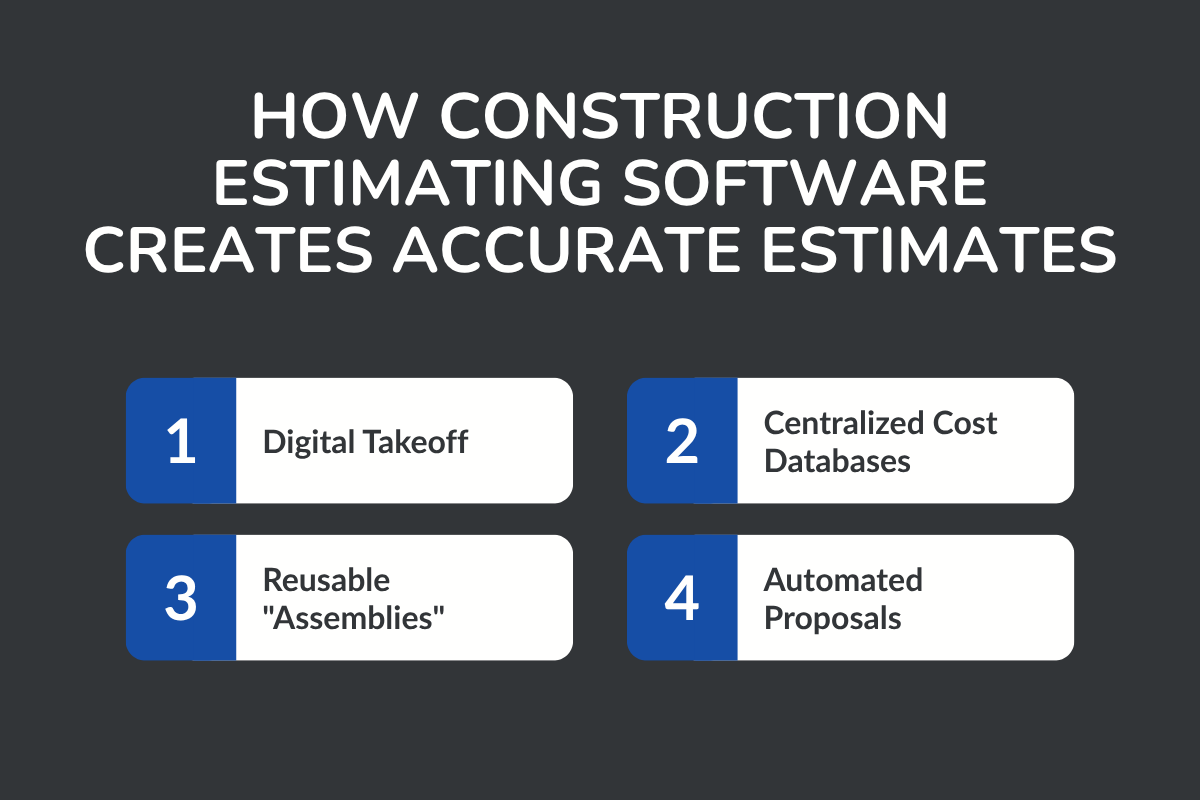
1. Digital Takeoff:
This is the first step. Instead of manually tracing blueprints, professional estimators upload a PDF or CAD file and perform the quantity takeoff directly on-screen.
These cuts take off time by 50-80% and ensure precise calculations for all construction materials.
2. Centralized Cost Databases:
This becomes your "single source of truth." Everyone on your team pulls from the same up-to-date pricing for construction materials, labor costs, and subcontractor bids.
When a vendor's accurate price for steel changes, you update it once, and that new unit cost is instantly used by everyone for all future bids.
3. Reusable "Assemblies":
This is a huge time-saver that prevents missed scope. Instead of pricing a wall by manually adding 10 individual items, an estimator clicks the "8-foot interior wall" assembly.
The estimating software instantly adds all bundled components (studs, drywall, labor cost calculations, and fasteners), ensuring that no direct costs are overlooked.
4. Automated Proposals:
Finally, the software auto-generates a professional, branded bid package based on your detailed estimates.
All your data, from direct costs to overhead costs, is compiled into a clean report for the project owner, eliminating the need for copy-pasting into a Word template and minimizing the risk of last-minute errors.
Explore the Construction CRM Best Practices for Subcontractors!
"Before" vs. "After": Manual or Automated? A Better Bidding Process
The impact of this transformation is best seen in a side-by-side comparison of a typical workflow.
| The "Before" (Manual Spreadsheets) | The "After" (Automated Software) |
|---|---|
| Morning: Hunt for the latest plan files and price lists in emails and shared drives. | Morning: Open the project dashboard. All plans, documents, and cost data are in one place. |
| Mid-Day: Manually measure and count items on a PDF, keying each number into a complex spreadsheet. | Mid-Day: Use digital takeoff tools to measure plans in minutes. Apply pre-built "assemblies" to build the estimate. |
| Afternoon: Frantically check formulas, copy-paste totals into a Word doc, and email Bid_v4_Final.xlsx to the team. | Afternoon: Review the auto-generated summary. The software flags any items with missing costs. Generate a professional bid package with one click. |
| Outcome: One bid completed in two days. High risk of errors. No reusable data. | Outcome: Completed two or three bids in one day. High accuracy. All data is saved for future analysis. |
The Real-World ROI: What Automation Actually Delivers
Adopting new construction estimating software is an investment. It’s not just about saving time; it's about fundamentally improving your construction business’s financial health.
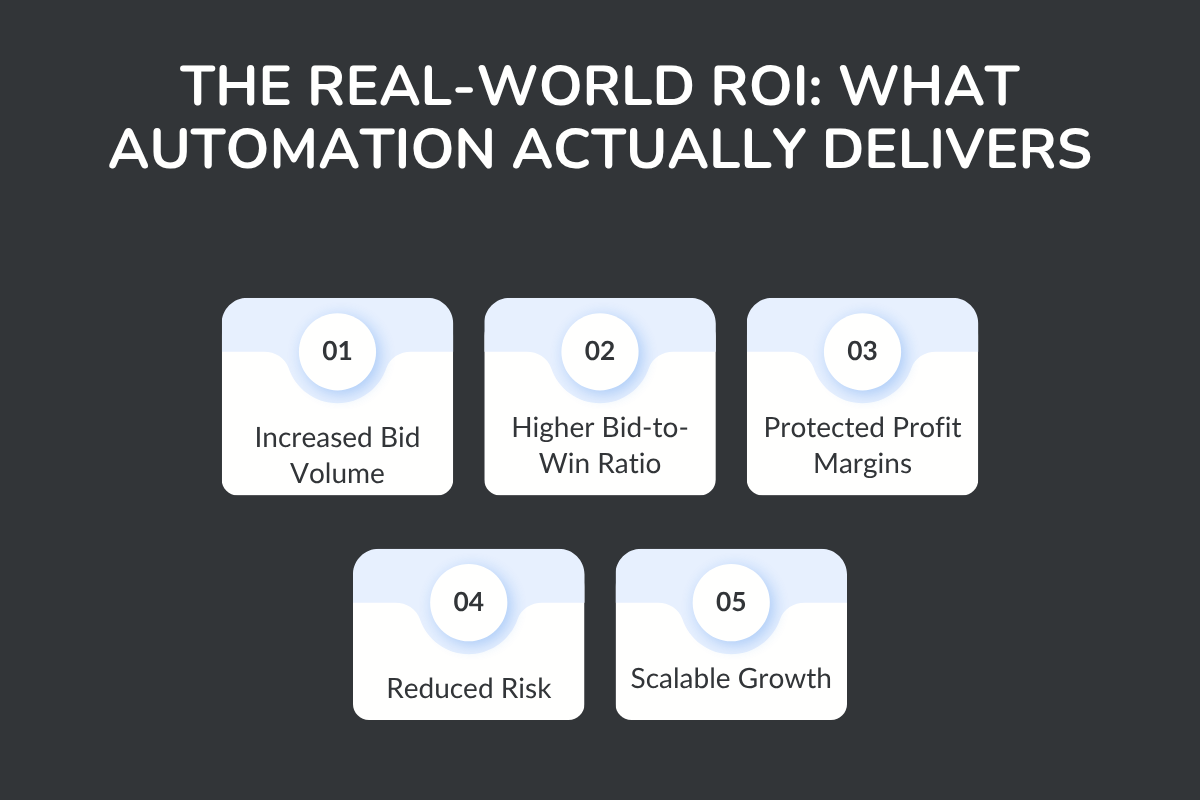
- Increased Bid Volume: When your team can complete a detailed estimate in hours instead of days, they can submit 2x-3x more bids, dramatically increasing your sales pipeline.
- Higher Bid-to-Win Ratio: A professional, transparent, and error-free bid package builds trust with project owners and gives your competitive bid a serious edge.
- Protected Profit Margins: This is the most critical ROI. By eliminating pricing errors and ensuring all scope is included, you stop "winning" unprofitable jobs.
- Scalable Growth: Automation breaks the "Spreadsheet Ceiling." You can finally grow your company's revenue without having to proportionally grow your back-office headcount.
Check out How Automated Bidding Works: Speeding Up Estimate Turnaround!
How to Choose the Right Construction Estimating Software

Once you've decided to automate, the next step is finding the right tool. Not all construction estimating software is created equal. Use this checklist to find the right fit:
A 5-Point Checklist for Your Next Estimating Software
- Is it Easy to use? The most powerful software is worthless if your team can't use it well. Prioritize a clean and intuitive interface, and request a free trial or demo.
- Does it integrate with Your Other Tools? Your software cannot exist in isolation. Look for key integrations with your project management and accounting platforms to avoid double-entry.
- Is it 100% Cloud-Based? The modern construction process is collaborative. Cloud-based software enables your team to collaborate in real-time, whether from the office or the job site.
- Is it Built for Your Trade? The needs of a general contractor differ from those of a specialty subcontractor. Find a platform designed specifically for your workflows.
- Is it Future-Proof? You're investing in a partner. Does the company offer reliable support and a product roadmap that includes new technology like AI?
Check out this construction estimating software that ticks all the boxes!
The Future: AI in Construction Cost Estimating
If automated software is the new standard, then Artificial Intelligence (AI) is the next evolution. AI is what transforms your estimating software from a reactive tool (that does what you tell it) into a proactive partner (that tells you what you need to know).
This move to data-driven estimating is a game-changer for complex projects. This new technology is already delivering results in two primary ways:
1. AI-Powered Takeoff (Automation)
This is the most immediate and impressive time-saver. Instead of you manually tracing blueprints, an AI engine scans your construction documents.
It's trained to identify and count all components based on your project specifications, every wall, every door, every light fixture, and every outlet, in a matter of minutes.
This doesn't just cut your quantity takeoff time by 90%; it also reduces human error, ensuring no part of the project scope is missed.
2. Predictive Risk Analysis (Intelligence)
This is where the real power lies. The AI learns from all of your past projects. It analyzes your historical data to spot trends you might miss. For example, it can analyze a new bid and flag a potential risk:
"Warning: Your labor costs for concrete work on your last three similar past projects were 22% higher than your initial estimate. We recommend you review this unit cost."
This AI-driven insight frees your senior estimators to stop being data-entry clerks and start being true strategists. They can now focus on high-value work, such as value engineering, managing overhead costs, and developing a more competitive bid.
Introducing the Solution: ConstructionBase
This integrated, AI-powered future of the construction industry is precisely why platforms like ConstructionBase are built.
It was designed from the ground up to systematically eliminate the "spreadsheet ceiling" and replace it with a single, end-to-end platform for the entire bidding process.
ConstructionBase is more than just another tool; it's a complete cost estimation workflow. It combines digital takeoff, a centralized cost database, and the powerful AI automation we just discussed into one seamless system.
It's designed to solve your biggest pain points:
- To fix the "slowdown" pain: It uses AI-Powered takeoff to automate your measurements, allowing your construction business to bid 3x-5x faster.
- To fix the "bidding error" pain: It provides a Unified Cost Database, ensuring your entire team works from one single source of truth for all construction materials, equipment, and labor costs.
- To fix the "collaboration nightmare" pain: It features seamless bid management and automated estimating, keeping all your construction documents, detailed reports, and team communication in one central hub. No more hunting for Bid_v4_Final.xlsx.
This is how you move from manual guesswork to building comprehensive estimates with speed, accuracy, and confidence.
Conclusion: Stop Gambling, Start Winning
The transition from manual spreadsheets to automated construction estimating is a necessary and strategic shift. The "spreadsheet ceiling" is a gamble, riddled with risks, outdated pricing, and collaboration chaos that limits your growth.
And modern construction estimating software is the answer. By embracing data-driven estimating and AI-powered tools, you ensure your accurate cost estimates protect your profits. Stop gambling on old methods.
About ConstructionBase
ConstructionBase is the all-in-one, AI-powered construction estimating platform that helps you bid faster, eliminate errors, and manage your entire workflow from one place.
Ready to break your "spreadsheet ceiling"? Get a demo of ConstructionBase today.
FAQs
What is construction estimation?
Construction estimation is the process of forecasting the total cost of a project, including materials, labor, and equipment.
Can ChatGPT estimate construction projects?
No, ChatGPT cannot perform detailed takeoffs or access real-time cost data. It can only assist with text-based tasks.
What is the top salary for a construction estimator?
Top-end salaries for senior or chief construction estimators in major markets can exceed $150,000 to $ 180,000 or more annually.
How hard is it to learn construction estimating?
It is moderately difficult. It requires strong mathematical skills, meticulous attention to detail, and a thorough understanding of construction processes.
Have questions or need personalized advice?
Talk to an Expert Today and let our construction specialists guide you to success.
Related Posts
Building Construction Project Software: Key Integration Points You’re Missing