“Software update required!” is a small ping that quickly turns into constant frustration, interrupting your regular workflow.
Every year brings another tech upgrade to keep the software's core features functional. The burden of continuous updates bloats your budget, disrupts schedules, and slows project progress.
But imagine having construction software that auto-updates to the latest technology and is built on three core pillars: AI-powered support, mobile platform accessibility, and sustainability compliance.
This is the superset combo already shaping the future of the construction industry. Therefore, this blog explores how the perfect construction management software can align with the futuristic era by delivering smarter, efficient, and profitable workflows!
Future-Ready Construction Management Software 2026: AI-driven, Mobile-Friendly, and Sustainability-Focused
Future-ready construction management software is a cloud-native, AI-driven platform that centralizes planning, field operations, and sustainability metrics into one mobile-first workspace. It’s designed to automate routine tasks (scheduling, punch-lists, progress tracking), surface predictive insights (delay risks, cost overruns), and enforce greener practices by measuring carbon, waste, and material efficiency.
Construction projects are getting faster, more complex, and more regulated — teams that rely on disconnected tools lose time, budget, and compliance traction
And as we are already submerged in the AI-driven era, where intelligent tools have taken the lead in reshaping construction projects, it now automates nearly every phase of a construction project, from operations, project planning, designing, and financial management.
Mobile devices have become the central nervous system of construction firms, keeping both field teams and office teams connected in real-time.
Moreover, sustainability is no longer optional and needs to be built into every construction workflow to meet the industry’s future-ready mandates.
Choosing the right construction management software with the key capabilities is the ultimate solution to step into the future seamlessly with zero workflow disruption and no downtime.
Key Takeaways:
- AI-powered predictive tools, sustainability-driven compliance tracking, and mobile-first solutions have transformed construction into a smarter, faster, and future-ready industry.
- It is essential to use construction management software with built-in capabilities to support the future-ready industry demands.
- Modern platforms like ConstructionBase benefit construction firms of all sizes, including SMEs with small teams and limited budgets, that automate workflows and simplify project management.
- It delivers centralized project control, rapid estimates, real-time tracking, safety and compliance support, and smarter decision-making through AI-powered insights, mobile accessibility, and ESG-ready alerts.
Cut Through the Noise
Power your workflow with the next-gen construction management software that integrates AI, mobile access, and sustainability principles, so you can level up strategies to stay ahead in the evolving industry trends. Start your upgrade today and see how modern construction software can reshape your operations for 2026 and beyond.
What Does 2026 and Beyond Hold for the Construction Industry?
The construction industry is projected to grow at a CAGR of 5.6% through 2029, rising from its current valuation of $15.78 trillion to an estimated $20.44 trillion.
The numbers say it all! The industry is rising fast, driven by rapid urbanization and industrialization, pushing every contractor to gear up and take full advantage of this booming market.
But growth brings its own set of complexities from strict compliance and ESG mandates to digital-first client expectations and AI-powered efficiency demands.
Construction companies must adapt to survive. As Charles Darwin said, “It is not the strongest or the most intelligent that survives, but the one most adaptable to change.”
So, upgrade to the right construction software to glide your projects faster, smoother, and smarter.
Why Continuous Software Evolution Matters in Construction Projects?
Software solutions in the construction industry often have a shorter lifespan than the buildings themselves. Version control is the key to keeping your software solutions in line with the evolving market needs.
Moreover, outdated software acts like a hidden bug, which leads to budget overruns from inaccurate financial tracking, communication breakdowns that disconnect teams, delayed deadlines, inefficient resource planning, and ultimately workflow damage where profits chip off.
Digital Priorities Are Shifting
Automation has surged threefold, rewriting the rules of construction with the powerful trio of AI, mobility, and sustainability shining in the spotlight.
Data-driven decisions, sustainable operations, and intelligent project management software are no longer optional; they are the only way to survive in the dynamically evolving industry.
Why 2026 Is a Turning Point?
- Competition in the construction industry has intensified, and complex projects have become the norm, with intricate urban designs and multiple stakeholders involved.
- Stricter regulations and rising sustainability expectations now act as a shield for construction companies, helping them avoid costly delays and reputation damage.
- Added labor expenses and the need for continuous safety monitoring to safeguard the workforce further increase operational costs and make bids less profitable.
Did you know? 89% construction firms in the US faced challenges in hiring skilled labor!
Trends Redefining Construction Management Software in 2026
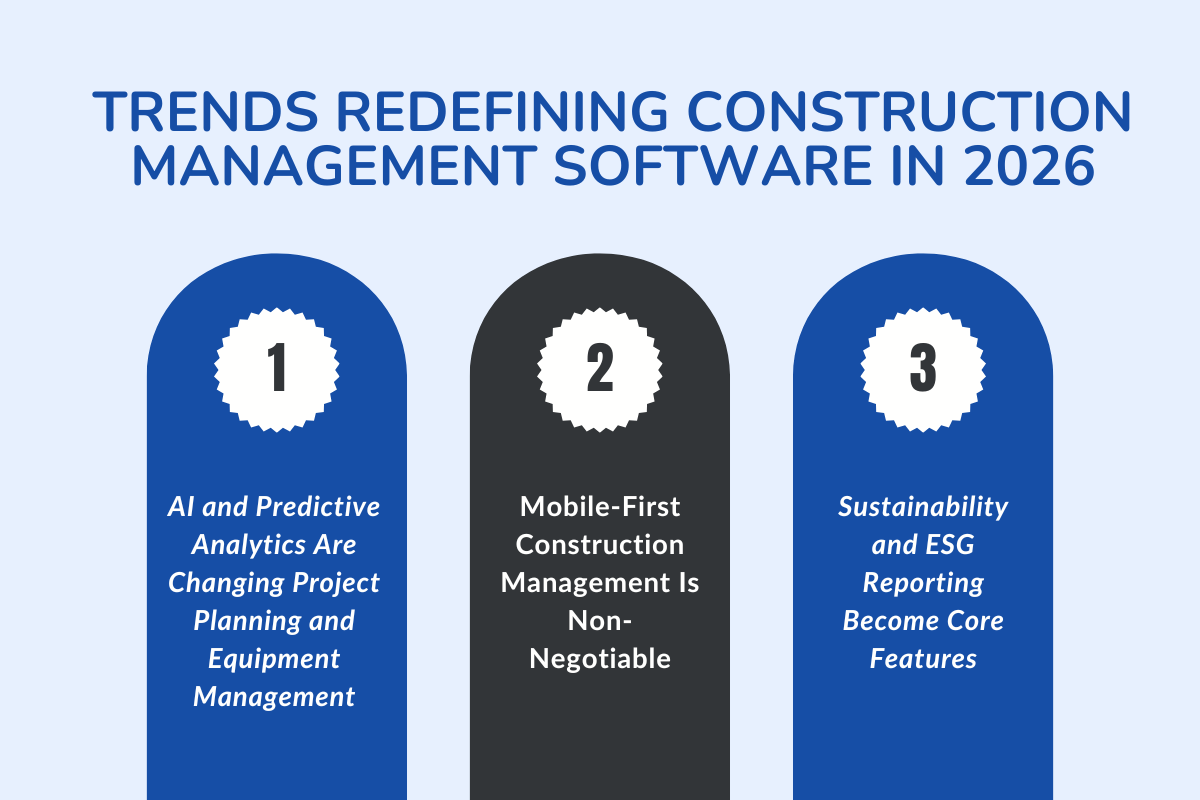
Trend #1 — AI and Predictive Analytics Are Changing Project Planning and Equipment Management
AI adoption in construction will accelerate and set new standards for efficiency, safety, and sustainability.
1. AI-Powered Estimation and Scheduling for Cost Control
AI predictive analysis and machine learning models use historical data to spot shifts in material prices, labour rates, and supply chain patterns to forecast future costs and disruptions with precision and plan proactively.
AI also analyses project requirements, workforce availability, equipment, and real-time site conditions to optimize scheduling, reduce labour idle time, and maximise resource usage to keep construction on schedule.
2. Predictive Maintenance and Safety Alerts With Real-Time Visibility
IoT sensors monitor equipment, site conditions, and worker status to trigger early-warning alerts before safety protocols are breached and hazards turn into construction site incidents.
AI predictive tools shift asset and compliance management from reactive to proactive by cutting down the operational costs arising from compliance violations and unexpected breakdowns.
3. Real ROI in Action
These numbers highlight the measurable improvements AI delivers to every contractor, from residential builders to large commercial firms.
- AI can improve cost accuracy by up to 20% by helping to predict the costs.
- AI-driven supply chain forecasting reduces errors by 20-50%
- Mid-sized contractors using AI-backed scheduling cut rework by 25%.
- Labour and equipment management become optimised and faster by 30% with AI-powered technology.
Explore More: The Rise of AI in Construction Project Management
Trend #2 — Mobile-First Construction Management Is Non-Negotiable
AI sets the strategy, but mobile accessibility is the tool to help construction managers work from anywhere and anytime with smarter and swifter project execution.
1. Mobile Access Is Now a Jobsite Essential
Team members instantly share progress, blueprints, photos, and documents through real-time tools to cut down miscommunications that bring costly rework and delays.
Mobile access enables quick sharing and feedback without meetings or calls, helping architects, engineers, and managers resolve issues faster and keep the project moving.
2. Offline Mode + Cloud Sync = Field Productivity
Mobile accessibility lets teams access and upload information anytime and anywhere by eliminating outdated data that can hurt construction project quality, blow budgets, and pose safety hazards.
Low connectivity is common on job sites due to limited infrastructure, but work never stalls with mobile devices supporting offline functionality, where field workers can record progress offline, and all updates sync automatically once they reconnect.
3. Eliminate Miscommunication
Mobile tools keep the remote teams synced to each other with instant safety alerts, project updates, and schedule changes for streamlining workflow.
Advanced mobile communication devices also offer bilingual support to connect diverse teams and clients, and overcome language barriers with ease.
Trend #3 — Sustainability and ESG Reporting Become Core Features
Green tech is the new winner, and construction management software must prove its ESG worth!
1. From Buzzword to Mandate: ESG Reporting
Growing environmental awareness and stricter mandates have made ESG compliance essential. Built-in carbon emission tracking and compliance reporting help reduce environmental impact and meet strict building codes.
2. Material Tracking & Waste Reduction
Carbon tracking, equipment monitoring, and waste-reduction insights help contractors stay compliant, make smarter purchasing decisions, and cut down on unnecessary inventory waste.
3. Sustainability That Pays for Itself
BIM software creates accurate digital building models with precise material quantities to reduce waste and improve cost control. It strengthens bidding by giving contractors reliable cost estimates for more competitive and profitable bids.
In What Way Do Unified Platforms Replace Disconnected Tools?
Tools must work together to work better. Unified platforms keep AI, mobile, and sustainability in sync. Let us explore how unified platforms can assemble your workflow into one powerful system!
1. One Dashboard, Not Ten Logins
Instead of juggling multiple tools, teams work from a single dashboard where every update syncs automatically.
This unified platform offers centralized access for AI insights, mobile field tools, and sustainability tracking, consistent project visibility across departments, fewer manual updates, and zero information gaps.
Everything you need—tasks, timelines, documents, budgets—is in one place. No switching tabs, no lost data, just clarity.
2. CRM, Estimating, and Accounting in One Flow
No separate sign-ins needed for estimation, accounting software, or CRM. The all-in-one solution is designed to revolutionize sales, estimating, accounting, and financial processes in the construction industry.
3. The Interoperability Revolution
Modern unified software solutions have an open API to support customisation to fit every unique construction company's needs.
It integrates effortlessly with top tools like CRM, accounting software, estimating apps, and Microsoft Project to keep projects on track and on time.
If you are still wondering about whether your company needs it or not, then check out: Construction Management Software: A 2026 Buyer’s Guide
How Automation & Low-Code Tools Empower Non-Tech Teams?
Modern software solutions are simpler, smarter, and streamline operations without the IT expertise! Let us explore how it can!
1. Everyday Workflow Automation Brings Real Impact
Auto-generated reports for sales, jobs, and staff productivity provide data-driven insights that guide strategic decisions, highlighting what works well and identifying bottlenecks that need rectification.
Team members stay synced with real-time communication and smart reminders for sales leads, payment dues, and inventory alerts, keeping the project timelines intact and cash flow healthy.
2. Low-Code Customization
It simplifies the creation of construction workflows through intuitive drag-and-drop tools. Site project managers can tweak these workflows without IT developers' expertise using robust drag-and-drop UI features.
How SMBs Benefit Most From Modern Construction Management Software?
1. Simplify and Scale with Future-Ready and Intuitive Software
Small and medium-sized businesses can transform with software solutions that have built-in features supporting future trends without the need for a large team of tech experts or a big budget.
2. Automate and Track Every Phase of Construction Projects
General contractors in SMEs can use the software to automate repetitive tasks, track budgets in real time, schedule efficiently, and gain full visibility into job progress.
It also improves client communication and leverages data-driven insights, ensuring no growth opportunities are missed while focusing on revenue-generating activities.
How to Prepare Your Construction Tech Stack for 2026?
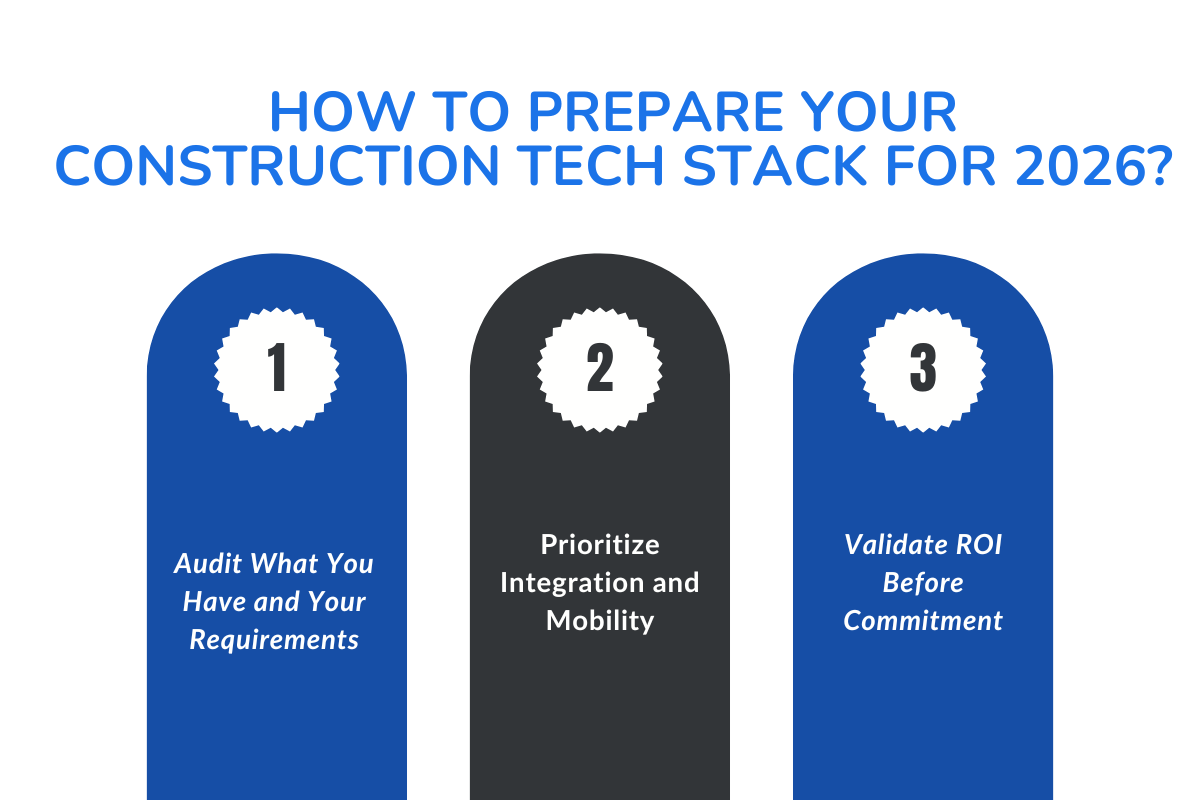
Ready to future-proof your Construction Team? Here are the tactical steps to roll out the software solutions.
Step 1 — Audit What You Have and Your Requirements
You may have construction software today, but can it maintain your project's health as the future unfolds?
You need to stop wasting time and money on unused tools that cause budget overruns and identify the core tools you really need to keep the construction site’s workflow smooth sailing.
- Get input from your construction crew to understand which parts of the current workflow slow them down or make it harder to adapt to new tools and industry trends.
- Evaluate every feature in your construction management software—how often each tool is actually used, its impact on daily operations, and any hidden costs—to determine the true ROI of every paid feature.
Step 2 — Prioritize Integration and Mobility
Juggling multiple tools is an old-school habit that slows down project timelines, creates chaos, and opens avenues for costly errors.
You have to pick the right construction management software with the right tools that help you get complete control over cost tracking, job performance, and resource allocations from a single unified platform.
- Cloud-based platforms can help you scale your business without extra feature purchases or upgrades, staying updated with dynamic market changes for easy scalability.
- Mobile accessibility works as a portable office to keep project managers, engineers, and field techs connected and synced with shared real-time access to project details anytime and anywhere across multiple sites.
Step 3 — Validate ROI Before Commitment
A construction management software should boost productivity rather than create chaos for project owners. It must simplify workflow processes and function effectively.
A quick evaluation checklist before implementation helps test real usability and potential ROI. Ask yourself the following questions:
- Can team members navigate the software features and use them without extensive tech training?
- Does it streamline scheduling, tracking, and reporting?
- Does it support an integrated ecosystem connecting existing tools like CRM, accounting systems, or BIM?
- Does the software have real-time expense tracking, job updates, compliance monitoring, and safety alerts?
- Can it handle multiple projects and expand with company growth?
- Does it provide actionable insights on job and sales performance, and crew productivity for decision-making?
- Does it save time, reduce errors, and improve resource allocation to save operational cost and boost profit?
- Is there continuous vendor support and training resources available after software purchase?
Tip for the Trade: Pilot test your construction software with a small team. See how it truly fits into your workflow and measure the real ROI without guesswork based on measurable results!
Best Construction Software For Leading In 2026
Construction professionals searching for the best software platforms for construction management can get a sneak peek into the industry’s top-rated options!
| Platform | Best For | Key Capabilities | Pros (What Teams Love) | Cons / Limitations | 2026 Readiness (AI, Mobile, Sustainability) | Pricing |
|---|---|---|---|---|---|---|
| ConstructionBase | Contractors wanting an all-in-one workflow from CRM → Estimating → Job Costing → Accounting | Unified CRM, AI estimating, digital takeoffs, job costing, scheduling, billing, and a mobile app | • Fully unified platform (no tool hopping) • AI-assisted estimating & forecasting • Easiest onboarding for teams | • Newer platform, fewer marketplace integrations | AI-ready, mobile-first, sustainability metrics available; built for unified workflows | Available on demo/request |
| Procore Technologies | Large commercial contractors & enterprise-grade projects | Project management, document control, quality & safety, financials, multi-stakeholder collaboration | • Extremely powerful for complex jobs • Massive integration ecosystem • Strong audit trails & compliance tools | • Expensive for small teams • Steep learning curve | AI features via Procore AI, carbon-tracking partner integrations, and strong mobile tools | Offers custom quote-based pricing |
| BuilderTrend Management Software | Residential builders, remodelers, and mid-sized firms | Pre-sales CRM, scheduling, change orders, selections, client portal, budgeting | • Clean client communication tools • Great for residential workflows | • Not ideal for very large commercial jobs | Mobile-friendly, cloud-based, solid automation features; limited AI depth | Pricing is not publicly listed. It uses a customized quote-based pricing model |
| Fieldwire Jobsite Management Software | Field crews who need fast coordination and task management | Task assignments, punch lists, plan markups, and real-time jobsite updates | • Very easy for crews to adopt • Strong offline mode • Great for field documentation | • Lacks advanced financial and estimating tools | Strong mobile support; early-stage AI automation; sustainability depends on integrations | Basic- $0 per user/ month Pro- $30 per user/ month Business- $64 per user/ month Business Plus- $89 per user/ month |
| Autodesk Construction Cloud | BIM-driven projects needing deep coordination | BIM management, 3D/4D modeling, clash detection, and advanced data insights | • Industry-leading BIM tools • AI-powered risk prediction • Ideal for large design-build teams | • Requires training + higher cost • Complex for small contractors | Advanced AI (Autodesk AI Assistant), sustainability scoring, and powerful digital workflows | Does not publish fixed pricing. The pricing is provided through custom quotes |
| Jonas Construction Software | Specialty trades & companies needing advanced financial tracking | Work orders, service management, inventory, payroll, and accounting | • Deep accounting features • Great for specialty contractors • Strong financial reporting | • Older interface and limited mobile UX | Cloud upgrades available; limited AI automation; strong for compliance & financial accuracy | Uses a custom pricing model |
The ROI of Adopting Modern Construction Management Software
1. Efficiency That Pays Off
Modern software cuts out a lot of the daily friction—fewer back-and-forth calls, less guesswork, and faster updates from the field. Teams can see tasks in real time, projects move more smoothly, and resources get used more wisely.
You also get practical insights you can act on, such as which bids are landing, where teams are slowing down, and how current projects compare to past ones. It becomes much easier to make decisions when the numbers are right in front of you.
2. Compliance Made Simple
Compliance becomes easier when the software organizes reports, sends timely alerts, and makes sure nothing slips through the cracks.
Safety also gets easier to manage. You can see issues as they happen, track incidents, and even spot patterns that might point to risks on upcoming jobs. It’s a straightforward way to stay ahead of compliance and protect your team.
3. Long-Term Competitive Edge
Construction management software with cloud-based platforms can seamlessly add new users and locations to its workflow, giving expanding companies a strong advantage in managing multiple complex projects.
Moreover, CRM software that delivers an instant client communication portal, automates personalized follow-ups, and provides transparent project status updates strengthens client trust and satisfaction.
Final Takeaway — The Future of Construction Is Smart, Simple, and Sustainable
The construction industry now brings together AI, mobile accessibility, and sustainability, not as separate entities, but as a unified path that drives the industry forward. To excel in the construction industry in 2026, you need both innovation and adaptability.
Construction teams no longer have the luxury of working with outdated tools, disconnected systems, or workflows held together by spreadsheets and guesswork.
The future demands unified platforms that think ahead, evolve with your needs, and eliminate the friction slowing down your projects.
Therefore, investing in future-ready construction management software is a tech upgrade and the foundation for faster builds, safer jobsites, confident compliance, stronger client relationships, and long-term profitability.
About ConstructionBase: Secure and Streamline Your Construction Business with the Next-Gen Construction Software
The time to act is now by stepping into a smarter and greener future for the construction industry.
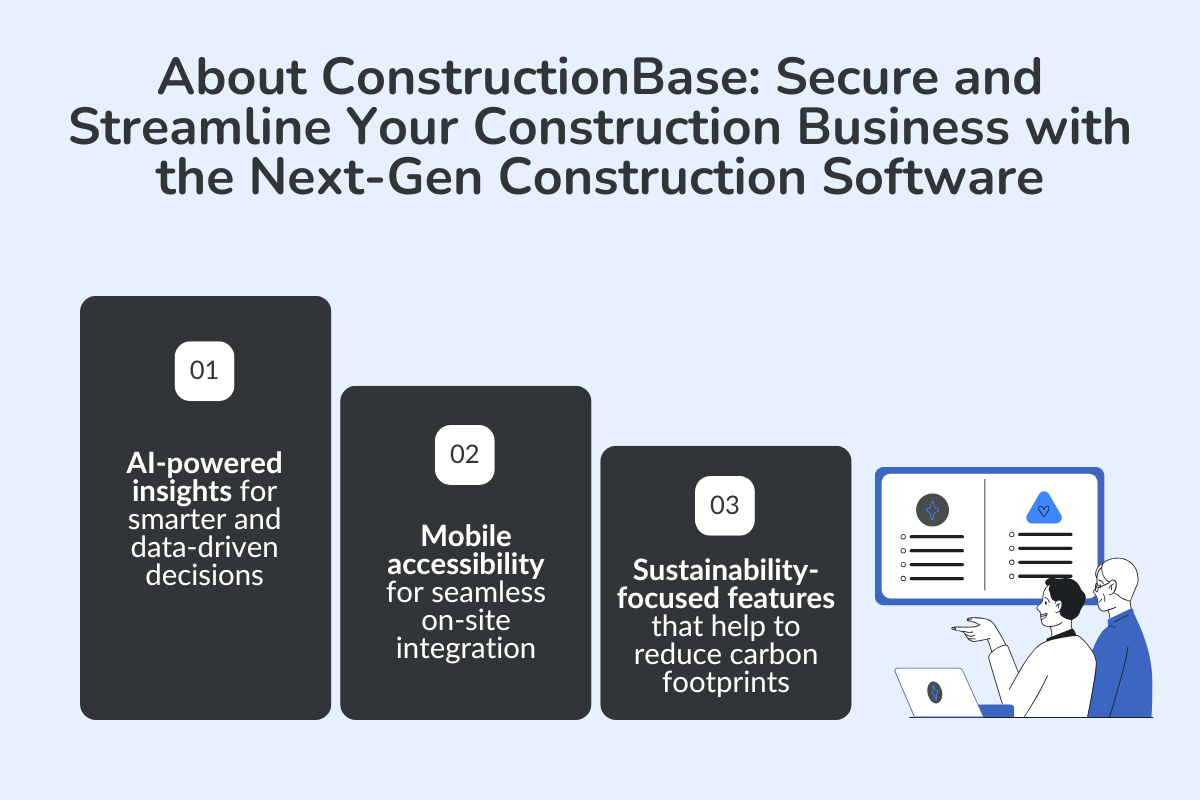
The rules of construction are changing fast, and ConstructionBase Workflow automation now brings:
- AI-powered insights for smarter and data-driven decisions
- Mobile accessibility for seamless on-site integration
- Sustainability-focused features that help to reduce carbon footprints
Join us in shaping the future of construction with confidence. Book a Personalised Demo and experience a complete walkthrough of the software, where you can see every feature come alive and deliver exactly what it promises.
FAQs
1. What is the Biggest Construction Software Trend to Watch in 2026?
The biggest trend in 2026 is the integration of AI-driven features into construction management software. These solutions will include predictive analytics, real-time tracking, and mobile accessibility to optimize scheduling, monitor budgets, and provide actionable insights across the entire project lifecycle, enhancing efficiency and decision-making on every job site.
2. How do I know if a construction software upgrade will give real ROI in 2026?
When you compare the costs and estimated benefits, a one-time investment that generates long-term profits can be reflected in higher profit margins, healthy cash flow, increased customer retention, and smoother project flow, demonstrating a positive ROI.
3. Is AI-powered construction management software suitable for both commercial and residential construction projects?
AI-powered construction management software is suitable for both commercial projects and residential builders, helping to improve efficiency, reduce costs, and enhance overall project operations.
Have questions or need personalized advice?
Talk to an Expert Today and let our construction specialists guide you to success.
Related Posts
Building Construction Project Software: Key Integration Points You’re Missing